 |
|
|
Jewish World Review March 17, 2000 /10 Adar II, 5760
http://www.jewishworldreview.com --
IT MAY SEEM ODD to look to the Pope as a source of illumination on matters
of Jewish belief and practice. But the leader of the world's Catholics
proved to be precisely that, when, on his recent trip to Egypt, he made a
visit to Mount Sinai. His pilgrimage to the site underscored the fact that
G-d's revelation to the Jewish people at Sinai is a basic fact of history
for Christians, as it is for Jews.
To be sure, the millennia-old memory of the encounter at Sinai remains most
vivid for the nation that experienced it. Not only is the Torah's divine
origin a central tenet of Orthodox belief, but, according to a recent survey
of Jewish opinion by the American Jewish Committee, it is affirmed by a
clear majority of all American Jews today, as well as by most Israeli Jews.
Whatever one makes of the revisions that those critical theories have
undergone in the last 75 years and counting, and they are many, one thing is
certain. As the late Professor Leo Strauss trenchantly observed in his
Philosophy and Law, the savants of the Enlightenment, in their onslaught
against religion and biblical historicity, never truly engaged the entire
concept of revelation; they merely posited its non-existence, elevated that
assumption to the status of fact and proceeded from there. "For that
reason", wrote Strauss, "Orthodoxy, unchanged in its essence, was able to
outlast the attack of the Enlightenment and all later attacks and retreats."
How ironic, then, that the Pope's Sinai visit has drawn the attention of the
world, and, hopefully, the interest of some who would rather not engage what
Sinai stands for.
This acknowledgement of the Jews' status as G-d's chosen nation, coming from
a prince of the Church, is nothing short of astounding. Although the survey
cited above also registered the conviction of most American Jews that G-d
indeed has a special relationship with our people, it has become fashionable
in some Jewish circles to de-emphasize this most central Jewish concept or
reject it altogether.
And that's unfortunate.
Admittedly, the idea of chosenness runs counter to the contemporary dogmas
of one-size-fits-all pluralism. But properly understood, based on its
sources in Torah, it is, in fact, a strikingly progressive, even
universalistic ideal. Because far from providing license to denigrate other
peoples, our chosen status has one overarching purpose: to fashion a model
community of spiritual living and moral excellence for all the world to
emulate.
It's a strange world, with Catholics providing valuable Jewish lessons to
Jews. But as the Talmud teaches, we are to endeavor to "learn from every
Pointer from the Pope
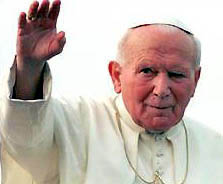
By Eytan Kobre
 While the theories of biblical criticism that arose in the mid-19th century
strove mightily to undermine the historical basis of the Torah, it is today
acknowledged by a great many in academia that the central premises of that
effort have been shown to have been, in the words of the Egyptologist
Kenneth Kitchen, "an appalling bungle."
While the theories of biblical criticism that arose in the mid-19th century
strove mightily to undermine the historical basis of the Torah, it is today
acknowledged by a great many in academia that the central premises of that
effort have been shown to have been, in the words of the Egyptologist
Kenneth Kitchen, "an appalling bungle."
 Interestingly, this was not the only time in recent months that a Catholic
leader has given Jews some Jewish food for thought. Just this past
September, New York's Cardinal O'Connor, in a letter that was read from the
pulpit in many synagogues, spoke of G-d as having "chosen Israel as his
particular people that they may be an example of faithfulness for all the
nations of the earth."
Interestingly, this was not the only time in recent months that a Catholic
leader has given Jews some Jewish food for thought. Just this past
September, New York's Cardinal O'Connor, in a letter that was read from the
pulpit in many synagogues, spoke of G-d as having "chosen Israel as his
particular people that they may be an example of faithfulness for all the
nations of the earth."
 More, it is an ideal which, if instilled in our youth, could do much to halt
our community's accelerating slide into the abyss of assimilation. Because
when one's people has a special, exalted mission in history, he or she will
very likely want to live in a way that reflects that mission. And when one
is part of a nation with a heroic past and a glorious destiny, it's only
natural to want to marry a fellow Jew to keep that legacy alive.
More, it is an ideal which, if instilled in our youth, could do much to halt
our community's accelerating slide into the abyss of assimilation. Because
when one's people has a special, exalted mission in history, he or she will
very likely want to live in a way that reflects that mission. And when one
is part of a nation with a heroic past and a glorious destiny, it's only
natural to want to marry a fellow Jew to keep that legacy alive.

Eytan Kobre is a lawyer residing in Queens and part of Am Echad's pool of
writers. Send your comments by clicking here.

