
|
|
|
Jewish World Review Feb. 3, 1998 / 17 Shevat, 5759
FOR ME, THE MOST TOUCHING SCENE in the Steven Spielberg film Schindler’s
List is the last one, in which the real-life survivors who were saved by
Oskar Schindler and their descendants file by his grave. Their presence
gives vivid testimony to the truth of the Talmudic dictum that he who
saves a single life has saved an entire world.
On Dec. 24, the 4th of Tevet, a Jewish hero directly responsible for
organizing visaless immigration that saved at least 40,000 entire worlds
died at his home in Beltsville, Md. Dr. William Perl, 92, was a key leader
of a rescue campaign known to friends and enemies alike as the Perl
transports. Having recognized the Nazi danger early enough to save
himself, Perl nevertheless remained in harm's way to effect the
evacuation of as many Jews as possible to Palestine.
The 40,000 Jews,
the majority of them chosen for their ability and willingness to help build
up Eretz Yisrael and fight for a Jewish state, not only saved their own
lives by joining a Perl transport, but also may well have helped tip the
balance in favor of the Jews during and after Israel's War of
Independence.
The lawyer was Perl, and after
a few moments of "nightmarish paralysis," Perl piqued Eichmann’s
curiosity by telling him about a plan that would expedite the Nazi goal of
rendering Vienna Judenrein (free of Jews). Eichmann recognized that
bringing large numbers of Jews to Palestine would not advance ultimate
Nazi goals, but Perl, having survived the original death threat,
outmaneuvered him. He went over Eichmann's head and convinced the
Reich to authorize currency transfers that would enable his group to
equip and outfit ships, make necessary bribes and pay the captains and
crews for transporting their human cargo.
Perl was a leader in the Zionist Revisionist movement, and a key member
of a group known as Die Aktion. The dire straits of European Jewry
dictated that Die Aktion fight what Perl described as a "four-front war."
The group pitted itself against the Nazis, who were closing in on
community after community, knowing that at any time the Nazis could
stop the operations and arrest and kill its organizers. It had to prevail
against the machinations of the British, who did everything they could to
prevent Jews from entering Palestine. The transport organizers had to
overcome the timidity, even hostility, of a Jewish establishment that not
only disparaged the rescue efforts as too risky, but in some cases even
worked with the British to thwart them.
They also had to battle the
elements: extreme weather, rivers made unnavigable by ice and rough
open seas that exacerbated the problems of hunger and disease. And
yet time and again, Perl pulled off schemes of such audacity that his foes
ended up doing what they had never meant to do, often without realizing
who had manipulated them. In the end, before the last escape hatch was
closed and Die Aktion ceased, tens of thousands of Jews had been
saved.
Speaking at his funeral, close friend Winnie Meiselman described Perl’s
cause as the physical and spiritual survival of the Jewish people.
Perl was among the first to fight for the Jews whose spiritual survival
was put at risk by Soviet policies. Having seen how little good quiet
diplomacy had done European Jewry during the Holocaust, he was
determined to make the biggest, splashiest fuss he could in order to
change American policy and put human rights in the forefront of
America’s Soviet policy. Again, he ruffled diplomatic feathers with his
staged demonstrations and protests, and earned the enmity of Jewish
groups who preferred to present a more dignified face.
But he helped
put the issue on the Jewish community's agenda, and the country's.
Those who knew Perl admired not only his brilliance as a strategist and
fearlessness as an advocate of the Jews, but also his personal
kindness, humor and abiding love for his wife, Lore; his sons, Solomon
and Raphael; family; and friends. Over the last two years before his
death, he was working with two authors on his autobiography.
I met Perl only once, spending a few hours with him in preparation of a
newspaper article. Still, I consider it one of the most significant days of
my life. Perl lived not by asking what can be done, but what must be
done, and then doing it.
It is almost impossible to think what might have happened had the people
on the Perl transports not made it to Palestine to fight for Israel’s
existence, or to imagine what Israel would look like today without the
influx of Soviet Jews who, in no small measure, owe their freedom to
Perl.
Fortunately, we don't have
William Perl: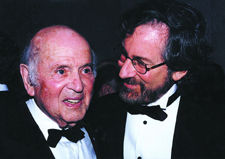
Perl with Steven Spielberg
A Jewish Hero's Life
By Deborah Cymrot
 The Four-Front War, Perl's 1979 book detailing and analyzing the rescue
effort (reissued in 1983 with an additional chapter as Operation Action),
reads in part almost like fiction. The first chapter, set in Vienna in 1938,
opens with a chilling description of an intelligent, efficient and ambitious,
but low-level, SS officer named Adolf Eichmann jamming the barrel of his
gun into a young Jewish lawyer's back and threatening to provide the
nearest pigsty with a little kosher meat.
The Four-Front War, Perl's 1979 book detailing and analyzing the rescue
effort (reissued in 1983 with an additional chapter as Operation Action),
reads in part almost like fiction. The first chapter, set in Vienna in 1938,
opens with a chilling description of an intelligent, efficient and ambitious,
but low-level, SS officer named Adolf Eichmann jamming the barrel of his
gun into a young Jewish lawyer's back and threatening to provide the
nearest pigsty with a little kosher meat.

Deborah Cymrot is community editor for
Washington Jewish Week.
