
|
|
|
http://www.jewishworldreview.com --
EVERY ONCE IN A WHILE, I wander out of my
neighborhood on Shabbes, the Sabbath. Sometimes, those
wanderings take me to a minyan that, while it's struggling
for members, makes up for it in ruach, or spirit.
Such is the case for this one particular group of men and
women. At this shul, synagogue, a man that the members
affectionately call the "little
kohain," or priest, gets up
each Saturday to bless the
congregation. Though not
practiced by most of Jewry,
such is the minhag, or
custom, of this group.
The man seems to be in the
comfort of his own religion, of his own prayers.
A recent moment, however, took me by surprise. We were
having a special kiddush, complete with a steamy
cholent and Middle Eastern salads and delicacies. I saw
the man who had blessed the congregation minutes
before put a challah under his coat and walk out the
door.
It wasn't just a piece of bread. It was the whole
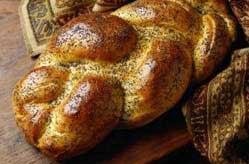
golden-brown braided loaf. I didn't know what to do. The
kohain? How could this be? I wanted to tell someone. I
wanted to approach the kohain and tell him to replace the
loaf. But soon you get caught up in conversation, the rest
of the kiddush-goers get going with song, and nothing is
done.
Then, the next time I visit the shul, the "little kohain"
comes up and blesses us again. I can't stay focused
because I remember what I had seen before. In the
crowded room of the kiddish later, I can't stop watching
him, as if I'm some sort of detective.
And he does it again!
This time, I went to the shul president. I wanted action.
Thou shalt not steal! Especially on Shabbes! Is nothing
sacred or holy?
Then I learned why I need to learn more.
The shul president smiled at me. Sure, he knew about the
challahs. Who do you think has been leaving the extra
challahs out there for the "little kohain?" The man's wife
is home in bed, sick and dying. He spends every moment
with her except when he comes to shul on Saturday. He
takes the challah home, says the motzi, the blessing over
bread, and feeds a piece to his wife.
He and his wife are helped by the Jewish agencies. Still,
it's not always going to be enough. No Jewish agency
can provide for him what this small minyan does.
"What's a challah or some extra food for him?" the shul
president asks. "Especially when you consider what he
does for us, every one of us, with the sacred prayers."
I had found out the story behind the story. I learned of
this man's social worker. I wanted to help.
SO MANY TIMES we human beings rush to judgment.
The "little kohain" brings up subjects of charity and how
a community goes out of its way to help. It also
addresses how much we have to know more about a
certain person, and are we being more of a help by
turning the other direction? Is it our business to be a
whistle-blower when we don't have enough information?
We can never forget that as neighbors in this living
organism we call the Jewish community, that we have an
accountability to the Creator. If that's too difficult a
concept to grasp, then we at least have an accountability
to each other.
The man I call the "little kohain" said: "May the L-rd bless
you and keep you," when he recited the Priestly
Blessing, as he fed our spiritual appetites. Later he said
the motzi and passed out small pieces of challah from the
minyan's kiddush table. I quietly put a couple of pieces in
my coat pocket to bring to my wife, who was home with a
cold. The challah was warm and tasted like cake. It was
better than what I had at home.
The "little kohain," though, caught my eye as I did it.
We were now
Jewish World Review Jan. 25, 2002 / 12 Shevat 5762
 The Little Kohain
The author discovers a novel minhag -- one of
compassion
By Phil Jacobs


Phil Jacobs is editor of the Baltimore Jewish Times. Send your comments by clicking here.
