 |
|
|
Jewish World Review Jan. 7, 1999 / 18 Teves, 5759
THE SPIRITS OF MILLIONS of older Americans soared with John
Glenn's courageous return to space. As one radio commentator put
it, Glenn proved that older people can do the same things that
younger ones can. Senior citizens had new reason to feel good
about themselves.
It is not difficult to see that older people fare much better in a
Torah society. After all, there will be very few retirees
beginning second careers as astronauts. In fact, it is downright
wrongheaded to imply that older folks can do all the same things
that younger ones can. It creates a burden that only the most fit
and able can bear. Why should we agree to value older people only
if they can do what younger ones can?
This expectation comes from the pernicious cult of youth that
pervades American culture. Consciously or otherwise, we attach
undue value to being fit, trim, and vigorous. Advertisements for
retirement communities, even cancer-treatment centers routinely
feature a graying couple brandishing tennis rackets. Younger
people look forward to retiring one day, in order to finally do
the things they wanted for decades. For many, though, that golden
opportunity will come just about the time that their bodies will
inform them of different realities. It does not occur to most
people that later life affords us the opportunity to grow in many
other areas that require a bit more tranquility and a bit less
distraction.
Is it any wonder that elder abuse is on the rise? That younger
people often feel so ill at ease in the company of the weak and
infirm? And that they, in turn, often feel useless and guilty for
surviving. When they can no longer smile at the 18th hole, is it
any wonder that they see themselves inexcusably competing for
vital resources that could be allocated so much more judiciously
to their club-wielding juniors?
This is a tragic state of affairs. Youth is wasted on the young,
people say. The contributions of old age, though, are also wasted
when the rest of us fail to appreciate what maturity really has to
offer.
Torah Jews have little trouble valuing their older members. They
enjoy advantages simply unavailable to their junior counterparts.
"Never trust anyone over thirty," many used to say. Precisely the
opposite occurs in Torah circles. We associate chronological
maturity with fully ripened sagacity, that rarely does a talmid
chacham (Torah scholar) "make it" to the top echelon of Torah leadership without
being eligible for AARP admission.
It wasn't only the
responsibility of the job which made Rav Elazar ben Azaryah's
beard turn a distinguished shade of gray when he assumed the
mantle of leadership. Had he not looked the part, his flock would
not have taken him quite as seriously!
(This point is
particularly appreciated here in Hollywood, where so many writers
find themselves unemployable by the time they hit forty!)
Think of the accomplishments of older Torah sages in our own
times. Mayor Ed Koch was puzzled by the massive outpouring of
grief at the funeral of Rav Moshe Feinstein, zatza"l. He couldn't
understand why everyone was so crushed. The man had lived, after
all, to a ripe old age! In a society in which older people are
routinely "turned out to pasture," he had no frame of reference
for a nonagenarian functioning as the single most important
halachic voice in the world!
Contemplate the Chofetz Chaim, Rabbi Yisroel Meir HaKohen,active past the century mark.
Consider (lehavdil beyn chayim l'chayim) Rav Leizer Shach, shlit"a, who
didn't assume his role of Sar HaYeshivos until around the age of ninety.
Ponder the anecdote about Rav Yaakov Kaminetsky, zatza"l, the late dean of Yeshiva Torah Vodaas, who
tried coming back to the rabbinic school in his eighties. When reminded
that he had retired a decade before, he retorted, "So how much
retirement can a person take?"
It is not only the isolated luminaries, however, who are valued
and respected in Torah circles. We see old age as the time in
which the wisdom of a lifetime cures and matures, and is shared
with a next generation eager to learn. Even when the backhand
fails, an athletically challenged older citizen may have little
trouble lobbing a crucial insight, perception, or reminiscence to
the next court.
This translated into more than just kind, respectful,
non-patronizing words addressed to seniors. We treat them
differently. We expect more of them, and offer them the
opportunities to produce, at more advanced ages.
While American
retirees seek out new cultural expression in ceramics and origami
classes, those in Israel (at least the males) have more meaningful
options. I, for one, am jealous of my father-in-law, who has the
daily privilege of learning in a kollel. In a program
tailor-made for older people (and also different from the other
kollelim in the neighborhood in that the participants pay the
institution, rather than the other way around!), he actually does
what he wanted to do for the many years that he was stuck in the
office. He is able to translate a less-demanding schedule into
quality learning time, and participate in passionate and deep
Torah study as well as anyone else.
The Maharal beautifully framed the advantages of aging. He
comments (Be'er HaGolah, Sixth Be'er, pg. 107) on the mitzvah to
rise in respect when an older person approaches (loose
translation):
The loosening of the bonds of the body, leaving behind the
transcendent soul, is cause for giving honor. We provide this
honor when the body leaves entirely, as in the eulogies we
deliver upon death. But we honor even the partial setting free of
the soul in old age. This is what is behind the Torah's
commandment that we should rise in the presence of the elderly.
The soul, he argues, is far more profound than the body. The
qualities that make us human reside much more in the soul than in
its physical counterpart. While the soul is attached to the body,
its power is muted and dimmed by the demands of the latter. As
the power of the body and its frenetic activity wane, the soul is
freed up to operate more independently, to be closer to its own
nature. In other words, a good backhand can be a burden. In a
sense, he seems to say, older people have purer souls. We rise in
respect of them.
Many in secular society have difficulty finding what to respect in
older people. They ask them to excel at what younger folks excel
at, and devalue them when they understandably cannot produce. Too
often, people measure others by the self-serving yardstick of what
they do best, rather than by what the other has mastered.
Effectively, they demand that others compete on a playing field
that will never be even. Boruch Hashem, Thank G-d we conduct ourselves
differently. We understand that in many areas, we younger folk
will never be the match of our
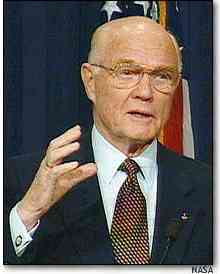
Glenn
John Glenn Meets
R' Elazar ben Azaryah
The elderly are society's greatest treasure. Too bad, these days, they must prove their worth.
By Yitzchok Adlerstein

Rabbi Yitzchok Adlerstein is
Director, Jewish Studies Institute of Yeshiva of Los Angeles and
the Simon Wiesenthal Center; Chair in Jewish Law and Ethics,
Loyola Law School and editor-in-chief of CROSSCURRENTS: An ejournal of Torah and current affairs. Send your comments to him by clicking here.

