
Jewish World Review May 4, 1999 /29 Nissan, 5760
 |
Tim Boxer
http://www.jewishworldreview.com --
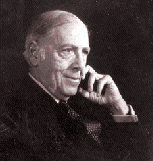
HERMAN WOUK, who accepted a Literary Achievement Award from Moshe Dworkin, president of the
Jewish Book Council, said he felt like Michelangelo.
At age 89, the great artist was told he had little more time to live. “Impossible!” he thundered. “I’m just
learning the ABCs of my craft!”
Wouk, a sprightly 85, was conflicted about accepting this lifetime achievement recognition at the 50th
annual National Jewish Book Awards at the 92nd Street Y. “There’s a shadow of tombstone about it,”
he said.
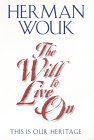
Although his latest book, "The Will to Live On," was just published by Cliff Street/HarperCollins, he still
has works of great importance on his desk in Palm Springs, Calif., which he has yet to attend to.
“Thank you for the award, but hold the gold watch,” he cracked.
Ever since he wrote his Pulitzer Prize-winning novel “The Caine Mutiny,” Wouk has been typecast as a
non-Jewish writer. Perhaps that was because, as he pointed out, most Jewish writers wrote about
alienation.
Calling that “a paradox of my career,” he thanked the Jewish Book Council for recognizing the Jewish
flavor of his work.
Wouk recalled sailing on the Queen Mary with his wife, Sarah. On deck he met Sholem Asch. “You’re
the author of ‘The Caine Mutiny’!” Asch declared in astonishment. “I thought you’d be a big blond goy!”
At dinner that day, Wouk’s table had the same food as the other guests, but kosher. Each item was
marked with a Star of David. Asch again was surprised. He said, “The author of ‘The Caine Mutiny’
keeps kosher and Sholem Asch doesn’t!”
DUMPING ON THE PRESS
“They believe that peace in the Middle East depends on the settlement between Israelis and Palestinians,”
he said. “That is not so. The peace has often been broken not by Israelis vs. Muslims but by Muslims
fighting against Muslims. Killing comes about not because of Israel’s power but because of murderous
Muslim dictators.”
Speaking from his unique perspective as a longtime editor and subsequent columnist at The New York
Times and now at the New York Daily News, Rosenthal has concluded that the media is biased in its
reporting on the Middle East.
The failure of reporters to discern this is due to their reliance upon government information, he said.
“Most journalists in the diplomatic press obtain their information from governments. They come to believe
what they’re told by governments. It doesn’t occur to them to dissect what they are told.”
A second mistake the press makes, he said, is believing that the biggest problem for Israel is bickering
among Jews. “You’d think that the Jew haters do not reside in Baghdad or Tehran but in government
offices in Jerusalem,” Rosenthal said.
Anti-Jewish propaganda, he said, is coming not only from Arab countries but also from India, Pakistan
and Africa. “They are the servers of hatred and filth. The American media fails to investigate this
anti-Semitism.”
Why the silence?
“It’s a matter of callousness. It’s exactly like the Christians in the U.S. who live with the knowledge of the
persecution of Christians in China and Sudan. It comes from insufficient acuteness and initiative on the
part of the media.”
He said that in the late ’50s he went to a party in Greenwich Village. Someone remarked that it was such
an interesting party.
“Why so?” Rosenthal asked.
“Everybody here is a Jew or a Muslim,” the person observed.
“I don’t think that party could take place today,” the columnist said.
HORSING AROUND IN JORDAN
“King Hussein knew of our movements,” Wircer said. “He approved because he too felt threatened by
the terrorists.”
One night the guard on duty was startled. He heard noises and began shooting. Then silence. In the
morning the soldiers found a dead horse. A newborn colt stood nearby.
“Apparently the horse made noise while giving birth,” Wircer said.
The soldiers were under strict orders not to take anything from the village, not even an orange. But the
22-year-old commander wanted to take the baby horse home to his kibbutz in the Galil.
When Gen. Ariel Sharon, then head of the Southern Command, came for a visit, the soldiers tried to hide
the horse. Sharon saw it and ordered them to leave it behind.
“We put the horse in a vehicle, covered with tarpaulin, and drove back across the border,” Wircer said
with a large grin. “Moshe Dayan, and Chief of Staff Chaim Bar Lev and Sharon were waiting to greet us.
We managed to sneak that horse right under their noses.”
Since then Yossi worked as a security officer with El Al, staying in the top hotels around the world.
Seeing firsthand how fine hotels operate served him well when the Sheraton hired him.
Yossi made a wise move in the matter of location. Instead of erecting a new structure on the traditional
hotel row on the Tel Aviv beach, congested as it is with tourists, he built the new hotel on the eastern side
of the city, in the suburb of Ramat Gan.
“This particular area was desolate,” he said. “There was nothing but garages here.”
The municipality decided to turn this part of town into a viable commercial center. Tax incentives drew
business. With new construction, the area evolved into the glittering Diamond Exchange District.
High tech facilities followed, including software companies such as Check Point and John Brice. Even the
South Africa embassy moved in. It’s now an exclusive neighborhood that attracts businessmen from
around the globe.
And at the center stands Yossi’s prized City Tower.
BOXER SHORT
“Why is she doing that?” he asked.
“She wants to improve her interpersonal relations,” his friend
11/17/99: Jewish Humor With the veep
Wouk Not Ready
For His Tombstone
“I had no sense of alienation. I had a heritage. It was in my blood, in my heart,” he said. “So I wrote in an
entirely different vein.”
Purchasng this book
-- linked in 4th paragraph --
helps fund JWR
A.M. Rosenthal, a journalist for 50 years, rebuked the media for what he calls their misconceptions of
the Middle East.
 At a Manhattan meeting of the Middle East Forum, a Philadelphia think tank headed by Daniel Pipes,
Rosenthal slammed the press for two major shortcomings. He said that no settlement between Israel and
the Palestinians could bring peace in the region, “not until the nature of the Muslim governments change.”
At a Manhattan meeting of the Middle East Forum, a Philadelphia think tank headed by Daniel Pipes,
Rosenthal slammed the press for two major shortcomings. He said that no settlement between Israel and
the Palestinians could bring peace in the region, “not until the nature of the Muslim governments change.”
Yossi Wircer, general manager of the new Sheraton City Tower in Tel Aviv, recalls with amusement the
month he spent on a secret military mission hunkered down in Jordan. It was 1970 when his platoon was
engaged in hunting Palestinian terrorists. They crossed the river and took over the Arab village of Safi,
abandoned by the inhabitants terrified by the PLO terrorists.
 Three years ago, Sheraton and Koor Industries launched Sheraton Israel with five hotels. (Today there
are 12 in the country.) Wircer helped develop new properties, including the purchase of the Moriah chain
and the building of Sheraton City Tower in Ramat Gan, of which he is now general manager.
Three years ago, Sheraton and Koor Industries launched Sheraton Israel with five hotels. (Today there
are 12 in the country.) Wircer helped develop new properties, including the purchase of the Moriah chain
and the building of Sheraton City Tower in Ramat Gan, of which he is now general manager.
Joshua Greene, producer of the documentary film “Witness: Voices from the Holocaust,” has a friend
whose daughter is seeing a therapist — on the Internet.

JWR contributor Tim Boxer is the celebrity columnist of the
New York Jewish
Week and author
of Jewish Celebrity Hall of Fame and Jewish Celebrity
Anecdotes. Send your comments to him by clicking here.


06/28/99: Always A godfather, never a god
06/25/99: You Never Know
06/01/99: A Tree Grows In Newark
05/17/99: Rock and religion