 |
|
|
Robert Leiter
http://www.jewishworldreview.com --
ANYONE who has had even a passing
acquaintance with college English
courses over the last half-century has
doubtless spent some time with a
Norton anthology.
W.W. Norton, the New York-based
publisher, has for years issued
anthologies of literature dealing with
English poetry and the American short
story and all sorts of sub-genres
throughout world literature.
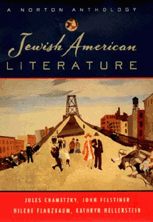
Now, there is a Norton Anthology of
Jewish American Literature, which took
four editors four years of intense discussion and labor to bring to
fruition. The hefty result weighs in at 1,221 pages.
One of the editors is Kathryn Hellerstein, senior fellow in Yiddish
and Jewish studies at the University of Pennsylvania, who said in a
recent interview that as far as she knows, this is the first
comprehensive book of its kind.
She and her fellow editors — Jules Chametzky of the University of
Massachusetts at Amherst, John Felstiner of Stanford University
and Hilene Flanzbaum of Butler University — strove "to look at the
literature in a comprehensive way. The book puts mid-17th century
writing together with Yiddish, Hebrew and a taste of Sephardic
literature, as well as Broadway lyrics and Jewish jokes."
The work begins in 1654 with a petition by Dutch Jews to Peter
Stuyvesant and ends in the present with a short story by Allegra
Goodman. Other writers anthologized include Anzia Yezierska,
Woody Allen, Gertrude Stein, Meyer Levin and Tess Slesinger.
"All of us were together in one room just once during the four years
— that was in 1996, when we signed the contract in the offices of
Norton. We did an enormous amount of Xeroxing and mailing of our
choices to one another. I don't know how many trees we killed to
make this anthology.
"There were lots of discussions on the phone
and by e-mail. What Philip Roth story should
we choose? Should we excerpt Henry Roth's
novel Call It Sleep or use one of his short
stories. Which poets should we include and
how many poems? But each of us had final
say over our sections."
According to Hellerstein, one of the questions
that was foremost in the editors' minds was
"What is teachable?"
"That meant weighing the old chestnuts against something new,"
she said. "In some sense, the anthology is a challenge to the idea
of canon, I suppose."
The publisher, while aiming the work for the classroom, clearly also
wants to attract the general reader. Hellerstein said ideally she
would like to see the anthology used by "teachers interested in
Jewish writers. Lots of different courses could come from this book.
But I'd also like to see every Bar and Bat Mitzvah child receive it as
a gift."
She paused and then with a chuckle said, "But I'd like every Jewish
high school graduate to get it, too. And public libraries and
synagogue libraries."
In fact, she said, she could think of lots of potential
A Jewish American Canon

Each of the four editors was assigned specific time periods to
oversee, Hellerstein explained.
"Hilene took the very earliest period and the present," she said. "I
took early 19th century and the immigrant period. Jules wanted
1924 to World War II, and John was happy with 1945 to 1973.
Hardcover- 1221 pages - W.W. Norton & Company


Robert Leiter is Literary Editor of the Philadelphia Jewish Exponent.

