 |
|
|
By Judy R. Gruen
My two grandfathers held one another in respectful, yet distant regard. My
mother's father, a Polish-born, Conservative rabbi, devoted his life to
Jewish education and study. He had little use for popular entertainment,
and, despite his keen intelligence, rarely appreciated the jokes the rest of
us found so funny.
My paternal grandfather's idea of a good time was playing practical jokes.
One of his favorite stunts was when he hired a kid in the neighborhood to
paint some small canvas, sign it "Eruoy Stun" and rave about the young
talent to others, who, like the admirers of the Emperor's new clothes,
clamored for other works by the youth. Decades later, Papa still chortled
when he recalled that "Eruoy Stun" was "You're nuts" spelled backward.
Papa Rosenfeld also had little use for G-d. He turned his back on religion
when, as a young boy, his father died, leaving his mother to raise him and
his five siblings in poverty. A rabbi told my grandfather that his father's
passing was "G-d's will," which promptly gave Papa an ax to grind against
organized Judaism for the rest of his life. As an adult, he became an active
proponent of secular humanism, even becoming president of the Southern
California chapter of the Secular Humanist Society.
Thinking about my very different, very beloved grandfathers reminds me of
the eternal struggle embodied in Chanukah: the forces of secularism
battling the uniquely powerful spirituality of Judaism. Papa Cohen wanted
little to do with secular society. While this probably had more to do with his
inherently serious personality than with the kind of palpable fear that many
of today's Orthodox Jews have toward secularism, he also feared the
impact of secular influences on his children and grandchildren. He was
right in many respects. Slowly, Jewish life mattered less and less to his
descendants. Today, only one of his surviving grandchildren keeps a
kosher home.
Despite their marked differences, I was drawn to and loved both my
grandfathers deeply. In a way, the friction between their philosophies
forced me to analyze just where I stood in the Jewish world. Like many
other Jews who have become more ritually observant as adults, I still
wonder: how can I live an authentically, spiritually rich Jewish life that's
balanced with the best that secular society has to offer?
Chanukah is all about the battle to preserve religious freedom amid
oppressive, state-mandated idolatry. The Syrian-Greeks imposed ever
harsher measures against the Jews, outlawing practices that were
fundamental to our lives: the celebrations of Shabbes, Rosh Chodesh (the
new month) and even Bris Milah . The brave, absurdly outnumbered
Maccabees, firm in their faith, answered this spiritual threat with a physical
response, while praying to G-d to help them succeed.
We in America enjoy tremendous religious freedom that our ancestors
could never have imagined. But unless we strike a healthy balance, our
freedom contains the seeds of an insidious threat to our spiritual lives. We
are bombarded with Hellenistic messages throughout the media and in
society in general; we still cannot be too rich or too thin. Invitations to "Just
Do It" shout louder than the quiet self-help books that encourage personal
reflection, self-discipline and altruism.
This reality makes Chanukah intensely relevant to our lives today.
Neither of my grandfathers managed to blend their Judaism with life in a
secular society. Each chose one and shunned the other. But when we
think about Chanukah and what it can teach us about how to find this
balance, we can look to Rabbi Samson Raphael Hirsch for enough enlightenment
to set thousands of menorahs aglow.
Rabbi Hirsch lived about a century before my grandfathers. Born in Hamburg on
June 20, 1808, he is known for his phenomenally rich and erudite
commentaries on the Five Books of Moses and other works. During his
lifetime, Rabbi Hirsch was criticized for pursuing secular education. In fact, he
enrolled at the University of Bonn, where he studied history, philosophy,
experimental physics and classical languages. His writing is dotted with
Latin, Greek, French and English phrases.
I have always admired Rabbi Hirsch because he never considered the pursuit of
secular knowledge as a compromise to Torah values. He wanted to
restore the historic connection Jews had always had with secular
knowledge, a practice that flourished during the golden ages of Babylonian
and Spanish Jewry, but which was later forbidden by our host nations.
Rabbi Hirsch insisted that attaining secular knowledge enhanced one's
appreciation for Torah:
"How can we understand the sublime word pictures of world history,
painted by the prophets without an adequate knowledge of contemporary
secular history? The Jewish youth who knows from his historical studies
[the contempt for human life shown by the ancient Egyptians], the social
oppression and moral degeneration in Rome of old, the oppression and
licentiousness of [ancient Greek society], understands and appreciates a
thousand times better the sublime and divine character of the Sinaitic
law... The Talmud reproaches those who fail to undertake it with the words
of Isaiah (5:12) 'And the doing of God they do not contemplate and the
work of His hands they do not see.'"
Rabbi Hirsch's involvement in academics also brought countless other
Enlightenment-era Jews, who were filled with doubts about the value and
veracity of the Torah, back to tradition. His slim volume, The Nineteen
Letters, is a fictitious correspondence (based on Rabbi Hirsch's own
experiences with university students) between a rabbi and a young
intellectual searching for some proof of G-d's existence.
The light of Chanukah recalls a miracle of dedication to our G-d and to our
religious values. Chanukah means dedication, but its root word, chinuch,
means education. When we light our menorahs in a window of our
homes, we share our small, humble light with our neighbors. We need not
choose between the light of Torah or the light of secularism. If rooted in
both Torah and the best that society has to offer, we will truly become a
light unto the
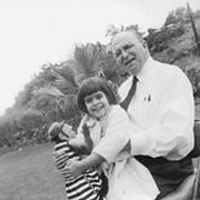
The author, 5, and her beloved
paternal grandfather

JWR contributor Judy R. Gruen has written forthe Los Angeles Times,
Washington Times,
Baltimore Jewish Times and many other publications.

