
|
|
|
MY FRIEND YONI (a pseudonym) is a ba'al teshuvah, a newly observant
Jew. He tells this story: He was meeting an old friend in a restaurant, a
treif (non-kosher) establishment -- in Texas, no less. No matter; Yoni was there to
meet, not eat.
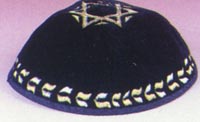
Like some Orthodox Jews, he wears a yarmulke (skullcap) in public and he has his
tzitzis (ritual fringes) out. He was thus outfitted that day in that restaurant, which
was probably a first for that eatery.
As Yoni got up to leave, a
restaurant employee eyed his dangling fringes and approached him
cautiously, incredulously.
"Excuse me, sir," the staffer whispered and then paused, searching for
the right words. "You have noodles hanging from your pockets."
Welcome to the world of the visible Jew. It can be a mighty interesting
place.
As the name implies, a visible Jew (a VJ) is one whose garb or other
externals publicly identify him or her as a Jew -- or possibly as a food
fetishist.
The markers: A yarmulke. Tzitzis. A fedora. Payes (sidelocks). The list goes on.
And for women, covered hair and modest attire, including long skirts
rather than pants.
What does it all add up to? If nothing else, visible Jewishness can be a
conversation-starter. Slap on a yarmulke, and people take notice. They ask
questions. Not always, but often enough to make things interesting.
A typical exchange: A Home Depot employee, a black guy, motored over to
me on his forklift and gave me a quick once-over. As usual, I was wearing
a yarmulke and had my tzitzis out. It was around Rosh Hashanah.
"Is this the holy season?" he asked.
I told him it was.
He asked me about the yomim tovim, (Jewish holy days) although he didn't use that term. I
told him about teshuvah, repentance.
He shook his head and smiled. "Gotta check out my soul," he said.
"Don't we all," I said.
The reaction from fellow Jews (non-VJs) runs the gamut, although many
seem to assume that the VJ (if a male) is a rabbi. Why else would a Jew
walk around that way in public?
Yet some Jews seem drawn to VJs. Maybe we're a visible link to something
they value, a remembrance. Sometimes we give them an opportunity to
declare their Jewishness. It's happened to me several times in the
checkout line at the supermarket. People who don't appear to be Jewish
will wish me a good yontif or go out of their way to say something in
Yiddish or Hebrew or make some other Jewish reference. They don't know me
from Abraham; but they do know I am a Jew. And they want it known that
they are, too.
A connection is formed -- however fleeting -- and it
wouldn't have happened otherwise.
I wonder how often these people have
the opportunity to interact Jewishly with a complete stranger. Not often
enough, probably. At times like that, being a VJ is a public service.
But there are strings attached, and I don't mean tzitzis. A visible Jew
is a de facto ambassador for an entire religion, and as a result, each of
us has a responsibility to maintain especially high ethical and moral
standards. Unfortunately, those standards aren't always met. For some VJs
(a distinct minority, I hope) externals are everything; they've
inculcated nothing. They are the Jewish version of "all hat and no
cattle."
In short, a VJ is not necessarily a better Jew, just an identifiable one,
which is still saying a lot. Not many Jews have taken this path, for it
is rarely the path of least resistance.
Why have we chosen it? For as
many reasons as there are VJs. Tradition. Custom. Ethnic pride. A sense
of heightened spirituality. Communal solidarity. Contrariness.
Separatism. Stiff-neckedness. Personal insecurity. Mishegas (Quirkiness). You name
it.
A yarmulke. Tzitzis. All the rest. "Props perhaps," wrote Baila Olidort
in a recent issue of "Wellsprings" magazine, "but they tell a story more
compelling than words." Ideally, they do.
My story is this: There are
times and places in which Jews have been forced to hide their Jewishness.
Thank G-d it's not here and now. I am a testament to that. When I cut my
grass, people know a Jew is behind the mower. When I do good, people know
a Jew did it. They can't not know. I am a fact on the ground --- a
remnant, a survivor, a visible link in a
Jewish World Review Jan. 11, 1999 / 22 Teves, 5759
 The visible Jew
By Richard Greenberg
 (And not just any Jew. For the most part, these are
unmistakable markers of Orthodoxy. How many non-Jews make the
denominational distinction, however, is anybody's guess.)
(And not just any Jew. For the most part, these are
unmistakable markers of Orthodoxy. How many non-Jews make the
denominational distinction, however, is anybody's guess.)

New JWR contributor Richard Greenberg is a Washington area writer and author of Pathways: Jews Who Return.
