 |
|
|
Jewish World Review May 23, 2000 / 18 Iyar, 5760
http://www.jewishworldreview.com --
ON LAG B’OMER, (today) thousands of Jews will flock to Meron, in the north of Israel, to
celebrate the yahrzeit of Rabbi Shimon bar Yochai.
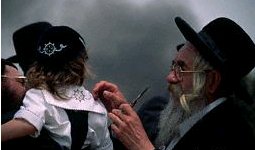
Many — Chasidim, in particular — will carry their three-year-old sons to the
high-vaulted tomb in which Rabbi Shimon is buried. There, the boys will have their
first haircuts.
Sephardic Jews will spend the night camping on the surrounding hillsides. They will slaughter sheep and goats for the day’s feast. All around, the hills will be alive with the sound of Jewish music.
Rabbi Shimon was one of the towering figures of second-century Palestinian Jewry.
For Rabbi Shimon, the Holy Land had everything a person could need.
When some of his students sought to leave for better material conditions elsewhere,
he did his best to dissuade them.
Corresponding to his love for Eretz Yisrael was his hatred of the Romans, whom
he despised for presuming to rule over the land he regarded as G-d’s special gift to
the Jewish people.
Rabbi Shimon was a man of the highest moral integrity and very particular about
treating people with respect. “Let a man cast himself into a fiery furnace rather than
humiliate another person in public,” he said on one occasion.
However, it is not for this that the crowds flock to Meron to mark the anniversary
of his death.
They go because Lag b’Omer is a kabbalistic celebration, and Rabbi Shimon’s is
the foremost name in Kabbalah (Jewish mysticism), being widely known as the
author of the Zohar, the most important kabbalistic work.
According to tradition, the years Rabbi Shimon hid in a cave were spent in esoteric
activity, radically altering his perception of life.
Lag b'Omer: The dimension beyond the Zohar’s doors
By Rabbi Arye Forta
 He studied under Rabbi Akiva and he, in turn, numbered such luminaries as Rabbi
Judah the Prince, compiler of the Mishnah, among his students. He was largely
responsible for steering the Jewish people through the Hadrianic persecutions.
He studied under Rabbi Akiva and he, in turn, numbered such luminaries as Rabbi
Judah the Prince, compiler of the Mishnah, among his students. He was largely
responsible for steering the Jewish people through the Hadrianic persecutions.

The Zohar first attracted popular attention in the 13th century. Since its publication, it has remained largely a hidden work, studied only by the very learned and pious.
And with much good reason. Misunderstanding and misuse of the Zohar have spawned charlatan healers, false messiahs and — since its translation into modern languages — even secular kabbalists the world over.
These days, it has even been used to lure holywood celebs into what some describe as a cult.
However, these things are remote from those who make the annual pilgrimage to Meron.
They know that the Zohar opened the door to a dimension beyond.
It describes not only the process of divine creation, the structure of the soul, and the nature of prophecy, but even shows how the Torah, correctly understood, is a window into the “personality” of G-d Himself.
The Zohar puts it in these terms: “The stories of the Torah are its outer garments. Woe to anyone who, looking at that garment, thinks it is the Torah itself…
“A person’s garments are plainly visible, but the pride of the garments is the person’s body, and the pride of the body is the soul. “Similarly, the Torah has a body, comprising its commandments, and that body is wrapped around in garments of stories.
“Stupid people see only the garment; those who are a little wiser penetrate to the body; but the really wise see right through to the soul… to the real Torah.”
This “real Torah” is nothing less than the supernal will and wisdom of G-d.
Studied and used properly, the Zohar can add new vistas to one’s understanding of Judaism and enhance the individual’s attachment to G-d. Most of those travelling to Meron and camping on the hillsides will not be conversant with its lore.
But they appreciate the fact that this path is available, and are ever thankful to the
man whose yahrzeit they are celebrating on Lag



03/15/00: Always tell the truth?
06/29/99: Contemplating the 's'-word
2/24/99: To do the work of angels
1/18/99: Making a sefer Torah of oneself