
|
 |
|
|
|
Jewish World Review Dec. 29, 1998 / 10 Teves, 5759
Artistic masterpiece
By Alan Oirich
IN A CASCADE OF COLOR and beauty in three-plus dimensions, DreamWorks
has carved itself a permanent place in the landscape of animation with
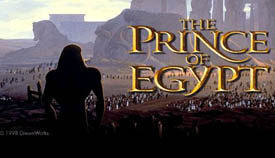
their first such feature release, The Prince of Egypt.
This powerful piece walks the fine line between entertainment and
biblical content, managing to ignore the damoclean omnipresence of its
predecessor - The Ten Commandments - until the imposing memory of Cecil
B. Demille’s 1956 classic fades before this film finishes its opening
musical number.
The Prince of Egypt comes into its own with lustrous animation, a
dazzling musical score, a fetching couple of plot turns, and the
humility to portray an abiding reverence for its sacred source material.
There is a tenacious balance about the whole procedure that is this
film, with a storyline and execution that manages to humanize Moses and
convey the universality of the story’s message without bleaching the
main character and his people of their identities.
Val Kilmer gives us the voice of the here-understated Hero. This Moses
is an everyman, from whom we are to learn that anyone can be inspired
and do great things. Kilmer starts out with a youthful exuberance and
his Moses becomes wizened, if not jaded, by the peculiar events of his
life. As we know, the Hebrews were slaves in Egypt. The Pharaoh gives
the order to kill all of the newborn Hebrew boys. Moses is set adrift in
a basket by his mother in a desperate bid for his life. These events are
articulated with a fabulous musical production piece "Deliver Us",
wherein the slaves are entreating their creator for salvation. The music
bounces from this, their darkest hour of desperation, to the faint
ripple of hope accompanying the little boy floating down the Nile.
The song is stunning, sometimes heartbreaking. Framed by enslaved
Hebrews pleading "deliver us!" the "Last Lullaby" is sung by Moses'
Mother Yocheved (the voice of Israeli pop superstar Ofra Haza).
She sings to the baby Moses enjoining the basketeer to try to remember
this last lullaby 'cause it'll have to last. Beginning with Hebrew words
of comfort, she continues in English:
"Hush now my baby. Be still, love. Don't cry.
In the audience, tears flow like . . . well . . . like the Nile as young
Miriam, after following the basket and seeing the queen take the baby
into the Pharaoh's house, ends the lullaby and sings:
"Brother, you're safe now and safe may you stay,
But before he becomes a deliverer, he becomes The Prince of Egypt. This
gives us what DreamWorks considers to be the substance of the story. As
distinct from the bitter perennial rivalry between Moses and his adopted
brother Ramses in The Ten Commandments (last time I’ll mention it) the
two putative siblings are here the closest of princely brothers. When
Moses discovers the truth of his heritage, his life changes; and to say
this changes the relationship of the brothers is an understatement of
biblical proportions.
The filmmakers over at DreamWorks went through
numerous script revisions and felt that the best version was this story
of two brothers, in a perhaps thinly veiled metaphor for brotherhood of
nations. Ralph Fiennes plays Moses’ adopted brother Ramses, who succeeds
his father as Pharaoh. His chiseled accent is perfect, as is his palette
of emotions: the warmth he feels for his brother, his respect and awe
for his father, his devotion to his culture, his regal pride, and his
palpable pain in the perceived betrayal of a brother who goes out to the
desert and returns with a command from an unknown deity.
Fiennes' acting
bursts out of the screen and makes for an almost uncomfortably
sympathetic Egyptian scion. The part has humor and strength and gives us
some inkling of what’s at stake when one sits on a throne. This, along
with Moses’ apprehension at afflicting his former brother, kingdom and
subjects, makes of the story the tale of two brothers the DreamWorks
team was shooting for.
A casualty of this focus is Jeff Goldblum as the voice of Aaron in a
disappointingly truncated role. Aaron, whom Moses discovers is his
long-lost brother, has had his role in the story radically diminished.
This, it would seem, in order to focus on Moses' relationship with
Ramses, his other brother. While the most substantive departure from the biblical
account is the absence of Aaron, it's all the more disappointing when
coupled with its limitation of the role of Jeff Goldblum, whose subdued
humor and brackish diffidence go sadly underused. While the bible
describes him as Moses' partner and spokesman, here Aaron could almost
be described as a "non-supporting character."
In this simplified version
he is not only deprived of much of his own personality, but, early on,
is invested with some of the characteristics of absent desert
insubordinates and Moses-critics Dathan and Korach, presumably because
someone thought the pain of another brother losing faith would cut more
deeply.
As for the hero, he’s a milder Moses. That’s fine, but the non-violent
approach, while laudable, seems vaguely non-committal and raises just
the faintest specter of a political correctness being imbued over the edge
of necessity.
The animation is truly like nothing ever seen before. After learning the
truth of his birthright, in a startlingly beautiful sequence, Moses
dreams in - one supposes - the prevailing medium of the time. His
nightmare features himself as well as the Pharaoh, his family and the
other Hebrews as animated full-color hieroglyphic wall paintings. Not
only is the look of these colored drawings moving on 3D-looking stone
walls an absolute inspiration, the drama of the dream itself is
overpowering as his nightmare gathers vague memories and recent
revelations into a frightening tableau.
After he leaves Egypt, Moses takes up with the family of Jethro, Sheikh
of Midian, whose particularly eligible daughter Tziporah (Moses' future
wife) is played by Michelle Pfeiffer. The part accomplishes wonderfully
what rival Disney seems to find so elusively difficult: having a woman
be strong for an actual reason - like strength of character - instead of
as some random sortie into an ill-defined battle of the sexes. Pfeiffer
carries the part beautifully, and takes the character from an
unflappably tough desert-dweller to a glowing newcomer among her
husband’s people. She suffuses the part with strength and dignity. She
also does her own singing, as did Fiennes.
Danny Glover plays Jethro, the big-hearted desert priest, while Brian
Stokes Mitchell does the singing for the same part. In the song "Look at
Your Life Through Heaven’s Eyes," Moses’ future father-in-law teaches
the former prince an important lesson: to look at a tapestry and see how
each strand can have no perception of how it fits into the whole.
As a shepherd in Midian, Moses follows a strayed lamb only to find a
sepulchral rock formation containing a burning bush. Here he encounters
the King of the Universe, who commands that he return to Egypt with a
mission.
He doesn’t want the job. In fact, he avoids it like the plagues, but the
Lord of his ancestors is insistent. And the stage is set for Moses’
return to the land of his birth.
PYRAMID SCAM
Sandra Bullock here has a dream role as the grown up voice of Moses’
sister Miriam. She’s a rock of strength and encouragement, this hearty
character, even carrying a tambourine into the Exodus, while modestly
seeming to forget that she inspired and encouraged her brother all
along.
The miracles, the plagues and, of course, the splitting sea, are all
unusually bright new uses of animation. Over the years, cried tears have
been considered notoriously flawed and fake-looking in the medium,
either too cartoony or too light, too milky or too watery. Here a
mixture of 3D modeling and standard methods achieves a look of depth and
reality. But tears aren’t the only liquid portrayed credibly here.
There’s water - lots of it. From the undulating Nile - a busy
thoroughfare conveying the baby Moses safely past crocodiles, fishermen
and barges - to the stupendous splaying of the red sea in a landmark
work of animation.
One of the most impressive things about The Prince of Egypt is the
old-fashioned way it handles certain issues. Once upon a time in
Hollywood, intimacy, violence and other delicate subjects were expressed
by a closed door, a close-up of a gun, or other indicia. Here, such
issues are handled in a way that you can bring your children to (unlike
Disney's Hercules, where the hero ends up swimming with corpses in the
underworld). For example, rather than showing Egyptian children dying
miserably during the last of the ten plagues, there are scenes like a
boy walking into a house carrying a clay jar. We hear a faint moan and
the jar crashing to the ground. A flopped hand expresses death in a way
that shows far more finesse than . . . say . . . a severed head might.
Helen Mirren plays the queen, Moses’ adopted mother, while Seti,
(Pharaoh senior) is played by Patrick Stewart. Both parts are small, and
needed very big actors to fill them out. And they do.
While The Prince of Egypt is neither a perfect recounting of a bible
story nor an entirely contemporary piece of pop culture, it succeeds at
being one of the most outstanding pieces of family entertainment in
years. It will win Academy Awards and will be considered a classic for
many many years to come.
Sleep as you're rocked by the stream.
Sleep and remember my last Lullaby
- so I'll be with you when you dream"
For I have a prayer just for you.
Grow baby brother, come back some day,
come and deliver us too."
In a couple of roles not quite up to the quality level of the rest of
the film, Steve Martin and Martin Short play two Egyptian High Priests.
Of this film’s beautiful array of songs by Steven Schwartz, the only dud
is the ill-conceived and relatively predictable "You’re Playing with the
Big Boys Now," which the pair performs in response to Moses’ report from
the desert. The Egyptian pantheon of empty animal-headed deities ends up
looking like a freak show punctuated by their own abrupt staccato
nomenclature. Still, the number serves as an inferior prelude to the
private reunion of the two princes who grew up together in the palace
only to pursue very different paths.

NEW JWR contributor Alan Oirich writes on cinema, entertainment and Jewish issues. He also
produces Jewish educational multimedia including the widely acclaimed "Jewish Hero Corps" comic on CD.
His column, "Film Night", featured in Israel's "Your Jerusalem" for several years, begins worldwide syndication with this review.