 |
|
|
At a time of year brimming with brightness and superficiality, Rabbi Avrohom Chaim Feuer offers us some thoughts on introspection and the true nature of the Chanukah lights.
OUR PROGRESSIVE AGE, by virtue of its countless advances and
discoveries, has been endowed with a great variety of names: the
For many centuries, man was actually half-blinded. Daylight
allowed his curious eyes the liberty of roaming at will, but come night,
man's free vision encountered a blinding darkness. Candles, oil, and
wood fires were the only means of dispersing the enveloping
gloom. These were either costly, hazardous, unsteady, malodorous, dim,
short-lived, or all of these. In those days, wax meant wealth, and
adequate light was a luxury reserved for the privileged. Many a
mastermind developed, and many a masterpiece was painstakingly created,
by the meager light of pale moonbeams.
Only recently -- barely a hundred years have elapsed since the invention
We tend to take the abundance of light for granted, for even if we
were seriously to evaluate the impact of light in its bountiful supply
on the lifestyle of Modern Man, it would probably be measured in terms
of convenience. But in truth, universal illumination is far more than a
pleasant fringe benefit of modern technology. It is a phenomenon that
has had a profound effect on the mentality of today's man. The genie of
the lamp has indeed performed a wondrous feat, altering the very nature of human life.
MODERN MAN is under constant distraction. Endless illumination has given
him the opportunity to become intensely aware of his surroundings, absorbed in fascination with the world around him, and oblivious to the entire cosmos within him. Modern
Man is pitifully neglected, for while he is scrutinized, analyzed and
categorized every fragment of his environment, he has ignored himself.
Modern Man suffers in self-imposed loneliness.
Early Man, Man-in-the-Dark, was sheltered from a great many
distinctions. The absence of technological sophistication was a
handicap, but it had rewards in other ways. Deprived of the ability
to view the World Without, Man-in-the-Dark was afforded an excellent opportunity
to focus his undivided attention on the World Within. In
the unlit hours he had nothing else to do but think, and so he thought
for himself and developed his unique identity and opinion. He was not
condemned to endure the pains of loneliness, but blessed with
the rich pleasures of solitude.
THE LIGHT OF THIRTY-SIX
No Jewish holiday so lends itself to the challenge of the Age of
Illumination as does the holiday of Chanukah, the Festival of Lights. If
in doubt as to which lights are being celebrated, one need only to consult our sacred literature and find that that these eight days are dedicated specifically to Inner Light, the internal
illumination that brightens the soul.
The Rokeach, Rabbi Eliezer of Worms, a noted medieval scholar and
authority, pointed out that a total of 36 candles are lit on the eight
days of Chanukah. This, he observes, corresponds to the first 36 hours
of Creation, when, according to Jewish tradition, a special unearthly
radiance lit the universe. This spiritual light was quite different from
any light we now know. It threatened to be too intense to serve
man's everyday, earthly needs, and so the Creator hid it from him. Yet that
light still exists -- in the Torah. For this reason, the
Aramaic term for Torah is Oraisa -- the source of light.
ONE MAY WONDER -- if it was destined for concealment, why did the
Actually, one need not be a lamed-vav'nik to uncover at least a portion
of this hidden light, for anyone who studies Torah with sincerity may
discover its splendor.
The 18th Century great, Rabbi Moishe Sofer, made the following
observation: "The two blessings that precede the recital of the morning
Shema prayer seem to be totally unrelated. First, in the blessing
Yoitzer HaMeoirois, we praise the Creator of the Heavenly Lights. Then
we proceed to an entirely different theme and in the blessing of Ahava
Rabba, we thank the Creator for giving us the Torah. There is a
significance in the juxtaposition, for nothing illustrates a point as
vividly as comparison. Torah is a source of light, and so are the
heavenly bodies. In the blessing of Yoitzer HaMeoirois, we observe
the limited external lights. It is then that we can truly
appreciate the penetrating and revealing inner light of the Torah, which
lights up our eyes and instills within us a deeper awareness of the
concealed dimensions of reality. 'Light up our eyes with Your Torah,' we
plead. External light and secular analysis at best can only illuminate
the object being studied. Torah, by contrast, lights up one's very
eyes."
EYE APPEAL
All of this, of course, is related to the Chanukah theme. But in dealing
with Chanukah, we must begin with the threat that brought the entire
Chanukah chapter in our history --- the Greeks and their mighty
civilization. Biblical Yavan, the prototypical Greek, was the son of Yefes
(Japhet), whose province was, the Torah tells us (Genesis 9:27),
yofi, aesthetics and eye-appealing beauty. The Creator endowed
Yefes with an extraordinary genius for the visual arts and skillfully
executed forms. However, the passage concludes, "but He will dwell in
the tents of Shem (Jewry)." Graceful shapes are only superficial, so
the Creator selected the inner chambers of the humble tents of Shem for
his place of dwelling.
Contours and shapes fascinated the early Greeks. The exquisite
curves and smoothly sculpted flesh of the human form were especially
dear to their sense of beauty. They were exhilarated by the
completion of the precise geometric forms and angles, and symmetrical
architectual colossi left them breathless. They also relished verbal
beauty. Flowing rhetoric and impressive sophistry enjoyed great
popularity. In short, appearance and form counted far more than inner
content. The package prevailed over the product. And when Socrates
started to search for substance, he was treated to a cup of the deadly
hemlock.
The Greeks followed their eyes. The Jews followed their souls. The Torah
warns: And you shall not stray after your hearts and after your
eyes (Numbers 15:39). The foremost commentator, Rashi, comments:
"The eyes see and the heart desires." Man's heart is caught up in
an eternal tug-o'-war. The eyes against the soul, the outer light
against the inner light. The eyes breed desire while the soul fosters
content. Each element seeks to overwhelm the other. This is the
kulturkampf of Yefes versus Shem, Greek versus Jew.
THE INWARD FOCUS
There was a time when it seemed as if the Greek conquerors of Judea would be victorious in this fierce ideological struggle. But the Chasmonaim (Hasmoneans), the priestly guardians of the inner sanctum,
entered the struggle and overcame the Greeks. The festival of Chanukah
commemorates their renovation and rededication of the Holy Temple.
But in truth, their main objective was to renovate and rededicate the
But why did they select the menorah for emphasis? The Talmud
(Shabbes 22b) questions the very necessity of a menorah in Jerusalem's
Holy Temple: "Did they need it for light? (They had ample light from
natural resources.) Rather, the light of the menorah was a testimony to
all the peoples of the world that the Creator's presence dwelt within
the Sanctuary."
Centuries ago, prior to the Age of Illumination, people did not waste
light. A fire with no function was promptly extinguished, and the fuel
was carefully hoarded. If the flames of the menorah burned constantly
without apparent function, it must have been that this was not light
made to shed external illumination, but rather to symbolize the inner
glory associated with Godliness.
FOR THIS REASON, it is prohibited, according to Halacha, or Judaic Law,
to use Chanukah candles as illumination for any ordinary activities.
Such utility would strip the candles of their essential message -- that
there is more than one kind of light, that of the soul besides that of
the eyes.
"The time for lighting the Chanukah candles is from sunset until the
time that the traffic ceases in the marketplace," states the Talmud
(Shabbes 21b) As long as men are involved in the affairs of the
marketplace, as long as they are engaged in the pursuit and purchase of
all their eyes see and their hearts desire, then they are still in
need of the lesson of the Chanukah menorah.
No doubt, our era is the age of the eye and the age of the market. This
is self-evident and does not need further elaboration. When before in
history has the consumer been flooded with such a staggering array of
tempting products, wrapped in millions of dollars of "eye-catching"
advertisement? When before has the human eye been so constantly exposed
to the distracting sights of the stage, screen, and street? In the Age
of Illumination, the outer lights have all but blotted out
the inner lights.
It is time to gather around the 36 candles of the menorah, and give the inner
lights the opportunity to convey their soft, subtle, penetrating
message.
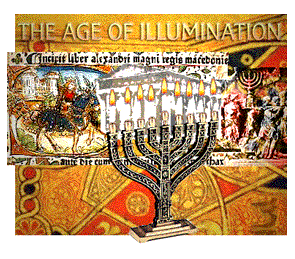 Computer Age, the Space Age, the Atomic Age --- to name but a few. May
we suggest yet another descriptive label? The Age of Illumination.
Computer Age, the Space Age, the Atomic Age --- to name but a few. May
we suggest yet another descriptive label? The Age of Illumination.
 of the lightbulb -- has Edison's genius transformed this bleak
situation. Today, mankind's blindness is banished by billions of
powerful and enduring bulbs. Artificial light has become so economically
feasible that even the poorest can afford to squander it. Everything
glows in the Age of Illumination.
of the lightbulb -- has Edison's genius transformed this bleak
situation. Today, mankind's blindness is banished by billions of
powerful and enduring bulbs. Artificial light has become so economically
feasible that even the poorest can afford to squander it. Everything
glows in the Age of Illumination.
 Creator ever fashion this form of light? The answer is
classically Jewish -- better a hidden light than no light at all. For
even though it is hidden, the light does exist and can be revealed to
anyone who sincerely strives to find it. Those few who have succeeded in
perceiving this light are the legendary lamed-vav'niks, the 36 righteous
men concealed from recognition in every generation. [In Hebrew, letters
are also used as numbers. The letters lamed and vav are the numerical equivalent of 36-- Ed.]
Creator ever fashion this form of light? The answer is
classically Jewish -- better a hidden light than no light at all. For
even though it is hidden, the light does exist and can be revealed to
anyone who sincerely strives to find it. Those few who have succeeded in
perceiving this light are the legendary lamed-vav'niks, the 36 righteous
men concealed from recognition in every generation. [In Hebrew, letters
are also used as numbers. The letters lamed and vav are the numerical equivalent of 36-- Ed.]
 Jewish heart. They had to rip the Jews' attention away from the outer
lights and focus it once again on the inner glow. They fashioned a new
menorah, not out of the customary metal, gold, but rather out of plain
iron rods (see the Talmud, Rosh HaShanah 24b). Aesthetics have a
prominent place in Torah philosophy, but only to the extent that the
external ornament serves to enhance the inner spirit. The Greeks had
taught the Jews to appreciate adornment purely for its own sake, to
accept beauty as independent value. The Chashmonaim sought to refute
that doctrine by practicing rigid simplicity.
Jewish heart. They had to rip the Jews' attention away from the outer
lights and focus it once again on the inner glow. They fashioned a new
menorah, not out of the customary metal, gold, but rather out of plain
iron rods (see the Talmud, Rosh HaShanah 24b). Aesthetics have a
prominent place in Torah philosophy, but only to the extent that the
external ornament serves to enhance the inner spirit. The Greeks had
taught the Jews to appreciate adornment purely for its own sake, to
accept beauty as independent value. The Chashmonaim sought to refute
that doctrine by practicing rigid simplicity.

Rabbi Avrohom Chaim Feuer, writer, author and lecturer of note,
is the
rav of Kehillas Beis Avrohom of Monsey, New York.

