
|
|
|
Jewish World Review Dec. 1, 2000 / 4 Kislev, 5761
Steve Lipman
http://www.jewishworldreview.com --
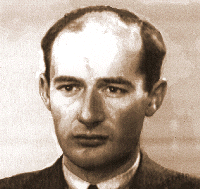
BIOGRAPHIES OF RAOUL WALLENBERG, the Swedish
hero of the Holocaust, always show the years of
his life as 1912-.
The missing figure was filled in this week.
After decades of Soviet denial, a Russian official
said Wallenberg, the scion of a wealthy banking
family who saved an estimated 100,000 Jewish
lives in Nazi-occupied Budapest and was arrested
by the Red Army near the end of World War II,
was shot and killed in Lubyanka prison in 1947.
"We must put an end to this story, which has
acquired an acute international significance and has been poisoning the atmosphere for a long
time," the Interfax news agency quoted Alexander Yakovlev as saying. Yakovlev, chairman of
Russia's presidential commission on rehabilitation of victims of political repression, said
President Vladimir Putin will soon issue a decree restoring the public name of Wallenberg, who
earlier had been accused of serving as spy against Russia.
Interfax did not specify on what evidence the Russian commission based its conclusions.
"If the report [of Yakovlev's admission] is accurate, it sheds light on what everyone suspected
and feared," says David Harris, executive director of the American Jewish Committee.
The AJCommittee has lobbied for a full disclosure of Wallenberg's fate since the late 1970s.
"It seemed obvious to us that Wallenberg was one of the guardian angels of the Jewish people
during the war. We could not rest while his fate remained unknown," Harris says.
Despite periodic reports from former Soviet prisoners of an elderly and ailing Swede in the
communist prison system, Soviet officials maintained that Wallenberg had been taken into
custody as a spy in January, 1945, and had died of a heart attack in the late 1940s.
"I would like to believe that [current Soviet leaders] have come to understand that facing history
rather than denying history is the proper way to proceed for civilized nations," Harris says.
Wallenberg, employed by the U.S. War Refugee Board, risked his life in 1944-45 to establish
"safe houses" for endangered Hungarian Jews, provide them false identity documents and
rescue them from trains bound for death camps. His case, largely unknown in the West, came
to public attention about 20 years ago following an article in The New York Times Magazine
written by the late Elenore Lester, a Jewish Week editor, and a campaign by several Jewish
and human rights organizations. Wallenberg received honorary American citizenship in 1981,
allowing the U.S. government to intervene on Wallenberg's behalf.
"This loomed very, very large," Harris says. "It was one of the great mysteries of the Second
World War."
Left unanswered by the initial reports of the Russian commission are several questions. Why
was Wallenberg arrested and imprisoned by the Russians? Why was he killed? Who killed him?
Where was he buried?
"It's always good to confirm the actual facts," says Efraim Zuroff, director of the Simon
Wiesenthal Center's Jerusalem office.
Zuroff recently called on the Russian government to publish all the documents relating to
Wallenberg's death.
A separate Swedish-Russian commission, which is investigating Wallenberg's fate, is to report
its findings in January.
"We anticipate that confirmation will come" eventually about this week's preliminary report of
Russian commission, Zuroff says.
He says the case still is not closed.
"We still want an explanation of exactly who is responsible, and [want the person] brought to
trial," Zuroff says, adding that Sweden has a statute of limitations on the prosecution of
murderers, while Russia does not. He says that the irony is that a trial of Wallenberg's accused
killer "can never happen in Sweden."
The emerging facts about Wallenberg's imprisonment and death interest the public today more
than in the post-war period, Zuroff says. "Raoul Wallenberg is a
Wallenberg mystery solved?


Steve Lipman is editor a staff writer of the
New York Jewish Week. Comment on this article by clicking here.

