
|
|
|
Jewish World Review Oct. 18, 2000/19 Tishrei 5761
http://www.jewishworldreview.com --
SOME PEOPLE gawked at the sight in front of the National Museum of Natural
History, while those who understood what it was smiled.
Little wonder: Bert Miller of Baltimore had transformed his ordinary four-door
station wagon into a sukkah so that he could fulfill the mitzvah (commandment)
of eating in a sukkah during Chol Homoed (intermediate days) of Sukkos.
Albeit tiny, this temporary booth was constructed in full compliance of Jewish
law, and in less than 60 seconds.
Since the day of the sukkah-on-the-Mall
years ago, Miller has put up his
miniature sukkah on many occasions
when he has been away from home.
The idea for this modern solution to a
problem — how to partake of meals in
a sukkah while on the go — came from
Rabbi Moshe Heinemann, head of the Star-K supervision service and rabbi of Agudath
Israel Congregation of Baltimore.
The problem it solves, however, is not
new. The Mishna Tractate Sukkah
discusses the acceptability of making a sukkah on top of a wagon, on the
deck of a ship, in the top of a tree or on the back of a camel. The latter two
possibilities, like the car sukkah, was ruled acceptable only on non-Yom Tov
days of Sukkos.
Miller has disseminated Heinemann's idea in The Eruv List and The Good
Book, annual guidebooks and phone book of the Orthodox communities of
Baltimore and Greater Washington that he publishes with his wife, Rachelle.
Each year, in fact, they publish a detailed "mitzvah tip" as well as a summary
of previous tips in the guidebooks because, Miller said, "it's my idea to
disseminate good ideas to promote Torah."
Miller, a math teacher who teaches in public high school, yeshiva and college,
said that Pirkei Avos speaks of "Ham'zakah es harabbim," one who
strengthens the community in its Torah observance. "I try to be a rabbim
zaker, a community strengthener."
In his quiet Park Heights neighborhood, Miller demonstrated car-sukkah
building techniques using his Volvo and about 15 lath strips for schach, the
roofing prescribed by Jewish law.
First, he moved the car from the driveway to right up against a curb, then
opened the doors on one side of the car all the way. (Minivan's sliding doors
will not allow for the 60-second sukkah.) The open doors sticking out are an
integral part of the structure.
The car doors form two of the walls. But a kosher sukkah needs at least three
walls that begin no more than 10.5 inches from the ground, and since the
Volvo door bottoms are a little higher than that, Miller used the curb to close
the gap between door bottom and ground.
He also could have wedged in pillows or some other material that would not
blow away in a normal wind. (Had the doors been lower to the ground, he
would not have needed the curb or pillows.)
The car itself constitutes a thick third wall, as long as the doors on the
opposite side from the sukkah remain closed.
A kosher sukkah needs a roof made entirely of natural materials, in their
natural state but severed from their source. It must provide more shade than
sun, while still allowing a view of the stars at night, and it must be at least 40
inches off the ground directly beneath it.
To build the roof, Miller first laid two of the wood strips along the tops of the
doors. (It's considered preferable not to have the wood roof sitting directly on
metal.) The top of the Volvo doors was high enough to satisfy Jewish law, but
those who want to make a sukkah with a little more headroom could use
thicker pieces of wood for the roof base, like two-by-fours, or a lower chair.
Finally, Miller placed the other strips across the first two pieces of lath. (Cut
bamboo or evergreens could also be used as portable schach, but can ooze
sap or shed needles inside the car while being transported.)
Miller then put a folding chair in the space right outside the car between the
front and rear door and sat down in a finished sukkah.
A little later, he reconfigured the lath, running the two base strips between the
two doors and the other ones parallel to the door tops. Either way of
constructing the roof is acceptable.
There's not much room in the sukkah — probably not enough for a chair and a
table. A sukkah's dining table must be within the sukkah itself, so the car seat
cannot be used as an eating surface, Miller said.
If there are multiple people who want to eat in the car sukkah, they will need to
take turns. It is possible to build twin sukkot, but it is a much more
complicated process, because there would then have to be a proper wall
erected along the car interior's length.
Although the car sukkah seems pretty simple to make, Miller recommended
building a practice sukkah in front of one's rabbi to ensure that everything is
done correctly.
Looking with satisfaction at the completed construction, Miller noted that
traveling with a car sukkah is a real pleasure. You don't have to research the
places where you'll be to make sure there's a communal sukkah in which to
eat.
"This can really free Jews so that they can travel more easily during Chol
Hamoed Sukkos," he
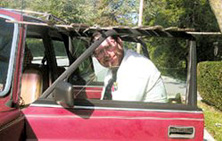 His sukkah, the car: Fulfilling a mitzvah of Sukkos — in a four-door sedan
By Deborah N. Cymrot
Washington Jewish Week



Deborah N. Cymrot is community editor for
Washington Jewish Week. Let her know what you think by clicking here.

