
|
|
|
Jewish World Review Oct. 12, 2000 / 13 Tishrei, 5761
http://www.jewishworldreview.com --
THE MOST ELIGIBLE Jewish bachelor from the former Soviet Union barely
takes his seat in a Midtown steakhouse, for a roundtable press
conference about his newfound fame, when the first question comes.
Do you want to get married now, asks a reporter for a Jewish
magazine.
Lenny Krayzelburg nods.
“Have I got a girl for you!” the reporter declares.
Krayzelburg blushes; he hears it all the time.
The king of the backstroke — three gold medals in three events at the
Summer Olympics in Sydney last month — is back in the USA for five
days, and he’s in demand. With journalists. With deal makers for endorsements. With prospective
suitors.
It started in Australia, on the Web site IBM set up for contacting American athletes. “I got more than
3,000 e-mails,” says the square-jawed Krayzelburg, his brushed-back blond face wan from two weeks
away from the pool, from days of running to interviews and talk show appearances.
Some of the e-mails were from plain sports fans, he says. Some were from Jewish fans exulting in the
success of the emigre from Odessa in Ukraine. Some were from interested women or their friends.
Krayzelburg, who turned 25 in Sydney and a few years ago was named one of the Most Beautiful
People in the World by People magazine, will take his time. He’ll wait until he’s back in Los Angeles,
where his family settled in 1989.
Krayzelburg says he is single by choice. Years of six-days-a-week training in the pool and weight room
leave little time for romance. “You have to make sacrifices,” he says.
With a two-month break from training, he will turn to the parts of life he has neglected.
“I definitely want to associate myself with the Jewish community more than before,” he says.
He’d like to speak at Jewish events, work for Jewish causes. “Is there a responsibility” as a highly
identified member of the community, he asks rhetorically. “If there is one, I’m willing to take it.”
Next summer he plans to compete in the Maccabiah Games. It will be his first time in Israel.
In 1993, “I couldn’t afford it,” Krayzelburg says. Four years later he was in the U.S. Nationals. He’ll
skip the Nationals in 2001.
Israel, he says, is “fascinating. It’s part of who I am.” He wants to tour the land, “go see the Wall.”
Krayzelburg is putting his hiatus time to good use. He’s already made a cereal box cover. He’s
schmoozed with Rosie and Letterman. He’ll be a Miss America judge.
“I don’t know what will happen,” he says of his sudden fame, adding that it hopes it will last until the
2001 Games in Athens. Krayzelburg says he will compete there, “if I stay healthy.”
As he speaks, Krayzelburg fingers the gold chain around his neck and a gold bracelet on his wrist. “I’ve
had them for years,” he says. “That actually is my favorite color.”
Krayzelburg, like most Jews of his generation from the former Soviet republics, was raised without a
Jewish education. He came here with his parents and sister to escape anti-Semitism, to avoid being
drafted into the Red Army. His story is well known to those who watched TV or read newspapers
during the Olympics.
“It’s a great example that anything is possible here,” he says.
“I’m always going to be referred to as an immigrant from Russia,” Krayzelburg says with the trace of an
accent, although his family became U.S. citizens in 1995. That’s fine with him.
“I don’t consider myself 100 percent” Americanized — he grew up in the Soviet Union, was educated
there, began swimming there, received his first instruction in his lifelong training habits.
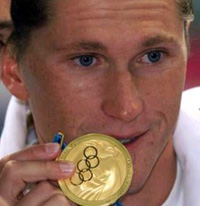
Between bites of a salad, his three gold medals lying on the table at Smith & Wollensky before him,
Krayzelburg fields questions about the Olympics.
He shared a room in the Olympic Village with another swimmer, calling his folks every day. They and his
sister were brought to Sydney by Speedo as part of his endorsement contract.
His parents, sitting in the stands at his meets, shouting encouragement in Russian, wearing large red, white
and blue hats, were the favorites of the TV cameras. “They’re really quiet people,” he says. “They would
prefer not to have the attention.”
Krayzelburg’s best Olympic memory? Meeting Muhammad Ali on the “Today” show. Just because it’s
Muhammad Ali.
“He just introduced himself,” Krayzelburg says. “He didn’t talk a lot.” Ali has Parkinson’s disease. “It
was hard to communicate with him.”
Krayzelburg had a reunion with the swimmers from the former Soviet Union, his one-time teammates and
competitors. All, he says, were “very supportive. I knew most of the athletes from Russia. They were
good friends.
“A lot of them want to come to America to train,” Krayzelburg says. In post-communist Russia, there is
little money for athletic facilities. “It’s tough to train there. The opportunities are not there.”
Many American gold winners were criticized for their in-your-face showboating and trash talking and
boasting. Krayzelburg was not among them; he publicly thanked his parents after every victory.
“You have to represent America with class and with style,” he says.
Krayzelburg’s answer is interrupted by a waiter admiring one of the medals.
“Can I show it to someone?” the waiter asks.
“Yeah, sure,” Krayzelburg says.
The waiter takes the medal to his coworkers, and Krayzelburg describes what he will do with the set
once he returns to his L.A. apartment. “I’ll put them on the wall with all my other medals.”
A reporter from Sports Illustrated peppers Krayzelburg with a list of questions.
“What means more to you, the three gold medals or being named one of the most beautiful people in the
world by Peo…?”
“Winning the three gold medals,” Krayzelburg answers before the question is completed.
He tells of a lunch meeting he had this year with John Nabor, a U.S. swimming star at the 1976 Summer
Games in Montreal, that helps him keep his fame in perspective. “It was his idea,” Krayzelburg says.
Nabor also had to balance the competing claims for his time. “He told me how not to get caught up in all
the media attention,” Krayzelburg says.
A last personal question. When he gets married, will he give his children the Jewish education he never
had?
Yes, Krayzelburg says. His home will be Jewish. “Maybe more religious than I
Lenny Makes N.Y. Splash
By Steve Lipman
 American women need not apply — he wants someone from his homeland. “Russian Jewish would be
ideal,” he says.
American women need not apply — he wants someone from his homeland. “Russian Jewish would be
ideal,” he says.

Steve Lipman is a staff writer with the
New York Jewish Week. Comment on this article by clicking here.
