
|
|
|
Jewish World Review Oct. 30, 2000 / 1 Mar-Cheshvan, 5761
Brigitte Dayan
http://www.jewishworldreview.com --
WHILE IN JERUSALEM last August, and at the urging of fellow
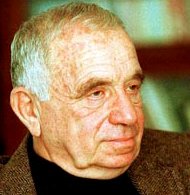
columnist and Jerusalemite Stuart Schoffman, I bought the latest -- and now
last -- collection of Yehuda Amichai's works: "Patuach Sagur Patuach," "Open
Closed Open."
I've long had a passion for Amichai's poems -- ever since I
researched his works and interviewed him for a 1994 JUF News profile --
and not only because I can understand Amichai's simple, direct Hebrew, but
because I can relate to his poems. That, to me, was Amichai's genius: he
creatively colored the world around him with motifs from the Bible and
Jewish history, and used them as a backdrop to understand the events and
thoughts of his life as an Israeli, and even more, as a Jew.
I've found myself referring back to Amichai more than once over the
last few weeks, ever since the violence in Israel escalated. Amichai died in
Jerusalem on Sept. 22, less than a week before the start of the bloody
clashes. In the midst of frenetically checking news Web sites, reading the
papers, and listening to the radio (all of which leave me feeling rather
enraged about the coverage), with the goal of anticipating the next move or
following up on the latest crisis -- the lynching of the Israeli soldiers,
the latest gun fight, the Israeli bombing -- there seems to be little time
for sweeping reflection, for the human implications beyond the cold facts
and the statistics. Yet, that is what Amichai did best. So what would he
have said, or better yet, what would he have written?
What would Amichai have written about the brutal lynching of the two
Israeli soldiers by a Palestinian mob in Ramallah, one of whom immigrated
from the former Soviet Union and whose pregnant wife called him on his cell
phone as the mob, aided by the Palestinian police, murdered him, and the
other, a feather of three and a toy salesman from Petach Tikvah?
"The diameter of the bomb was thirty centimeters
Would the bomb have been replaced by the mob in a newer version of the poem?
Surely, the diameter of the mob would extend from Ramallah to Petach Tivkah
to the former Soviet Union and beyond. As I learned more about the two
soldiers, I found Amichai's measurement particularly poignant.
Amichai wrote extensively about Jerusalem - his home since
emigrating from Germany as a 12-year-old in 1936-deploring both its feverish
extremes. In one of my favorite poems, "Tourists," he writes:
"Once I was sitting on the steps near the gate at David's Citadel and
I put down my two heavy baskets beside me. A group of tourists stood there
around their guide and I became their point of reference. 'You see that man
over there with the baskets? A little to the right of his head there's an
arch from the Roman period. A little to the right of his head. Redemption
will come only when they are told, 'Do you see that arch over there from the
Roman period? It doesn't matter, but near it, a little to the left and then
down a bit, there's a man who has just bought fruit and vegetables for his
family.'"
What would he say about the fighting spreading to his beloved
Jerusalem? Would it have added another layer of saturation to a city already
sated with history? Would he have turned to humor, as he did in the
following poem?
"Why is Jerusalem always referred to in a pair? Heavenly Jerusalem
and earthly Jerusalem?
Surely, Amichai would have turned to G-d, as he often did, not for
prayer or comfort, but for rebuke. Amichai's poetry bears an unmistakably
Jewish stamp with its generous references to specific prayers, biblical
events and characters, and Jewish history --- all of which, it seems,
illuminate his long-standing quarrel with a G-d he sought to understand but
didn't, with a G-d that seemed at times so close and at others so far. Would
this latest conflict have caused more theological wrestling? A poem in his
latest collection is insightful:
"'Our Father, Our King.' What does a father do
Above all, Amichai cried out for normalcy in a country and for a people that
have never experienced it. Perhaps the latest conflict would only have
served to remind him -- and us -- that such a normalcy is as intangible as the
G-d he tried so hard to
The diameter of the mob

And the diameter of its effectiveness range was about seven meters
With four dead and eleven wounded
And around these, in a larger circle
Of pain and time, two hospitals are scattered
And one graveyard. But the young woman
Who was buried in the city she came from
At a distance of more than a hundred kilometers
Enlarges the circle considerably,
And the solitary man mourning her death
At the distant shores of a country far across the sea
Includes the entire world in that circle."
(The diameter of the bomb, 1978)
I want to live in the Jerusalem in between."
when his children are orphans and he
is still alive? What will a father do when
his children have died and he becomes
a bereaved father for all eternity?"

JWR contributor Brigitte Dayan is managing editor of the
JUF News, a monthly published by the Jewish Federation of Metropolitan Chicago. Contact the author or the magazine by either clicking here, or calling (312) 444-2853.

