
|

|
|
|
|
Jewish World Review July 6, 2000 / 3 Tamuz, 5760
http://www.jewishworldreview.com --
THIS COLUMN, featuring a chance meeting between two Jews, one
American and one French, with the same last name, does not have a
miracle happy ending — at least not yet. But it does underscore the
bond of Jewish brotherhood around the world, and poses the notion
that American Jews should never take their democratic and religious
freedoms for granted.
The chance meeting took place in Paris, where
my wife and I were vacationing in honor of a milestone anniversary.
We were having dinner with Marc and Elsa Lustman, close friends
from Baltimore, also on vacation, at a small kosher restaurant in the
heart of the city’s Jewish neighborhood. Helping to augment our very
basic French, as we attempted to place our order with a waiter who
spoke no English, was a young Parisian who introduced himself as Stefan. It turned out that he was
studying orthodontics in St. Louis, which interested our friend Marc, who is a dentist. In the course of
conversation, Marc mentioned his last name, and Stefan said that it was also the name of his good friend,
Phillip, sitting a few tables away.
A moment later Stefan introduced Marc to Phillip, a 31-year-old Parisian in the real estate business, and
they agreed that Lustman is not such a common name. They asked each other about their respective
parents and grandparents, uncles and great-uncles, and where their families were from, trying to find a
common link. Marc’s late father, a Holocaust survivor, was from Poland. Phillip’s family had come from
Poland but his father was born in Paris.
None was apparent, though Philip and Marc later exchanged addresses, phone numbers and e-mail
addresses, promising to keep in touch and pursue the matter. Far from an exercise in futility, the
exchange created a warm and instant bond, reminding us of the precious legacy we share as Jews after
the Holocaust.
This lesson was particularly poignant for us as American Jews visiting Europe. The day before, we four
visited the Jewish Museum of Art and History, a powerful experience in itself. Located in the
restored Hotel de Saint-Aignan, a centuries-old mansion on the border of the Marais, the original Jewish
neighborhood of Paris, it charts the development of Jewish communities from medieval times to the
present, through their art, traditions and religious objects. The primary focus is on France, but also deals
with Western and North African communities that make up French Jewry today.
A common theme over the centuries was the fear that Jews lived with, wherever they settled, establishing
synagogues and communities despite religious persecution and anti-Semitism from their neighbors.
Even
after the French Revolution, civil rights came slowly to French Jewry.
One of the more compelling exhibits deals with the Dreyfus affair of a century ago and includes a photo
of the 1895 army ceremony during which the Jewish army officer, who had been falsely accused of
treason, was disgraced and demoted. He is shown standing ramrod straight as another officer breaks
Dreyfus’s sword over his knee.
Some say the French Jewish community has never recovered fully from that anti-Semitic episode and the
trauma of World War II, during which the Nazis invaded France. Some 90,000 Jews were deported,
only 3,000 of whom survived.
To this day the native Jewish population maintains a low profile, concerned in recent years about the
government’s pro-Arab Mideast stance and the popularity of far-rightist Jean-Marie Le Pen and his
Nationalist Front party.
More religiously and politically assertive have been the many immigrants from North African countries
who have come in the last several decades and now make up the majority of France’s Jewish
community, estimated at up to 800,000 — the third largest Jewish community outside of Israel.
Walking along the Rue Richer, only a few steps away from the now quiet Folies Bergere theater, a visitor
passes dozens of kosher restaurants, bakeries and chocolate shops. Tunisian cuisine is dominant, with
cous-cous the equivalent of kosher hot dogs in America.
On July 4, we happened to be at Versailles, the palace built by Louis XIV, the Sun god, whose lavish
taste knew no bounds. Seeing the vast size and splendor of the palace rooms, one understood why,
indeed, there was a French Revolution. The gap between the royals and the populace had simply grown
unbearable.
I realized that had I been at home, I probably would have marked Independence Day by engaging in
such less-than-patriotic activities as cleaning the garage and firing up the barbecue. But thousands of
miles from the U.S., I felt a surge of appreciation for the “liberty, equality and fraternity” that is not a
slogan but a way of life I too often take for granted.
Nothing like a trip to Europe to remind one how fortunate it is to be an American
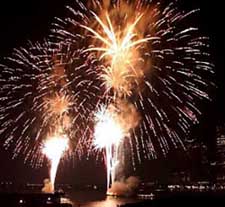 Celebrating July 4,
in France
By Gary Rosenblatt
 Twenty minutes later, during our meal, Philip returned, a cell phone pressed to his ear. He had his father
on the line and with growing excitement was trying to elicit more family history to determine a connection
with Marc’s family.
Twenty minutes later, during our meal, Philip returned, a cell phone pressed to his ear. He had his father
on the line and with growing excitement was trying to elicit more family history to determine a connection
with Marc’s family.

JWR contributor Gary Rosenblatt is Editor and Publisher of the
New York Jewish Week. Comment by clicking here.

