 |
Jewish World Review / June 22, 1999 /8 Tamuz, 5759
 |
Jewish identity
By Eric Fingerhut
Washington Jewish Week
(JWR) ---- (http://www.jewishworldreview.com)
AT A TIME when many experts think that the greatest threat to Jews in America
comes from within, a new survey shows many American Jews feel the outside
force of anti-Semitism is a much greater menace.
That was just one of the interesting findings in the American Jewish
Committee’s 1999 Survey of American Jewish Opinion. Telephone interviews were
conducted with 1,000 American Jews between March 29 and April 18, 1999; the
margin of error is plus or minus 3 percentage points.
By a margin of close to two-to-one, American Jews said anti-Semitism is a
greater threat to Jewish life in America than intermarriage --- 62 to 32
percent. Those numbers also reflect an increase from last year’s survey, in
which the split was 57 to 38 percent.
Pamela Nadell, director of the Jewish studies program at American University,
said a large factor in the results may have been the response to another
question in the survey --- 64 percent of those with married children have at
least one child who is intermarried.
While no breakdown of results for that particular subgroup was available,
those respondents with Jewish spouses themselves still chose anti-Semitism as
a greater threat, by a margin of 54 to 39 percent. The margin among those
with a non-Jewish husband or wife was much wider, 84 to 11 percent.
Even considered apart from intermarriage, though, anti-Semitism is seen as a
significant problem by the group of American Jews surveyed. Thirty-four
percent said anti-Semitism is currently a "very serious problem" and 63
percent said it is "somewhat of a problem."
Even more startling, when asked to look ahead over the next several years, 10
percent thought anti-Semitism in the United States would "increase greatly"
and 35 percent said it would "increase somewhat," while 44 percent felt it
would "remain the same" and only 8 percent said it would "decrease somewhat."
In addition, 44 percent of respondents disagreed with the statement,
"Virtually all positions of influence in the United States are open to Jews."
(Unlike other questions, there was a marked difference in response to that
question depending on age, with only 27 percent of those under 40 disagreeing
with the statement.)
"I just don’t get it," said Nadell. "Anti-Semitism is so negligible [now] as
to not be a significant threat," she said, noting the remarkable
transformation of attitudes in America over the last half-century.
"I find it really bizarre, and bad for the American Jewish community to the
extent that they are organized to deal with imaginary threats instead of
threats from within," said Abrams, president of the Ethics and Public Policy
Center.
Aaron Breitbart, senior researcher for the Simon Wiesenthal Center, said that
while less anti-Semitism exists today, it is "much more vocal" and evident,
due to the rise of the Internet and what he perceives as a greater tolerance
of intolerance, or "society’s relaxation of 'rules' " on what one should say
in public. "There are fewer people [who are anti-Semitic], but it sounds like
there are more in the U.S."
Breitbart said that while there will "always be anti-Semites," the more
insidious danger is assimilation. "We should make sure we don’t give Hitler a
posthumous victory," he said.
Another aspect of the survey which raised eyebrows was the finding that
"remembrance of the Holocaust" is the primary measure of identity for many
Jews. Twenty-four percent of American Jews rated it "extremely important" to
their Jewish identity, while 54 percent said it was "very important." The
only response that had anywhere close to similar numbers was "celebration of
Jewish holidays," with 17 percent calling it "extremely important" and 50
percent "very important." Other choices "participation in synagogue
services, Jewish study, travel to Israel and Jewish organizational activity"
were much less popular, all garnering less than 10 percent of respondents who
said such factors were "extremely important" and anywhere from 19 to 31
percent who called them "very important." (Jewish study received the highest
numbers, travel to Israel the lowest.)
Nadell felt similarly. "It’s clear that since 1967, American Jews engage in
remembering the Holocaust much more," she said, pointing out the
ubiquitousness of Holocaust remembrance in contemporary American culture,
from Holocaust education courses in schools to movies such as Schindler’s
List and the numerous Holocaust memoirs which have been published.
But she was troubled that so many Jews place such great importance on
Holocaust remembrance as a factor in their Jewish identity. "I don’t think
it’s healthy. Jews can’t hang their identity on that forever,” she said.
A related question found that close to one-half of
those surveyed consider "being part of the Jewish people" the quality most
important to their Jewish identity. Twenty-one percent said "commitment to
social justice" was the most important quality, and three percent said "support for Israel."
Only 15 percent responded
"religious
 "It’s very hard to understand the answer," said David Harris, executive
director of the AJCommittee. He said the best explanation for the numbers is
that "American Jews continue to be very conscious of Jewish history and
vulnerability," and that recent attention to the Holocaust, due to the many
museums and memorials throughout the country, has "reinforced lurking dangers
and the constant need for Jewish alertness."
"It’s very hard to understand the answer," said David Harris, executive
director of the AJCommittee. He said the best explanation for the numbers is
that "American Jews continue to be very conscious of Jewish history and
vulnerability," and that recent attention to the Holocaust, due to the many
museums and memorials throughout the country, has "reinforced lurking dangers
and the constant need for Jewish alertness."
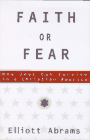
Elliott Abrams, author of the book Faith or Fear: How Jews Can Survive in a
Christian America, which argues that intermarriage is the biggest problem
facing American Jews today, agreed. While acknowledging that surveys of Jews
have shown similar findings for the last few decades, "the level of
anti-Semitism has decreased very much over the last 25 years."
Sales of this book
help fund JWR
 "As a child of Holocaust survivors, I would be the last person to suggest
that the Holocaust is not the central event in our lifetimes," said the
AJCommitee’s Harris. "But it can’t be allowed to become the alpha and omega
of Jewish identity."
"As a child of Holocaust survivors, I would be the last person to suggest
that the Holocaust is not the central event in our lifetimes," said the
AJCommitee’s Harris. "But it can’t be allowed to become the alpha and omega
of Jewish identity."

Eric Fingerhut is a staff reporter for Washington Jewish Week. Let him know what you think by clicking here.

