
|
|
|
Jewish World Review June 17 , 1999 / 3 Tamuz, 5759
(JTA) ---- A new Freedom Ride, honoring the
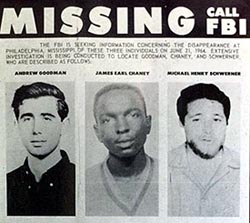
memories of three civil rights activists -- two Jewish and one black -- slain
during the 1964 "Freedom Summer" in Mississippi, is making its way south.
The weeklong trip of mostly black and Jewish activists, which left
Wednesday morning after a ceremony at the Museum of Jewish Heritage --
A Living Memorial to the Holocaust in New York, includes stops at
predominantly black universities and sites such as the U.S. Holocaust
Memorial Museum in Washington and the Civil Rights Memorial in
Montgomery, Ala.
For one Jewish participant, 55-year-old Allan Gould, the trip will be down
memory lane. As a college student in Detroit, Gould traveled down to
Mississippi during "Freedom Summer" to teach in a school. He was
stationed five miles from the site where the bodies of the Jewish and black
activists were found.
"I remember the fear and the camaraderie from that summer," he said. "It
was an almost ethereal time. We were working with people who were
stunned to see us down there.
At Gould's side was his 25-year-old son, Judah, who has grown up on
stories from that summer. "I want to walk the footsteps he walked," the
younger Gould explained, adding that he hoped the trip would also be one of
"personal growth."
As the activists set out to re-enact the freedom rides of the early 1960s,
black and Jewish lawmakers gathered in Washington on Wednesday to
honor the memories of the slain civil rights workers -- James Chaney,
Andrew Goodman and Michael Schwerner -- and to rededicate themselves
to the alliance that drew the black and Jewish communities together in the
civil rights struggle.
Reps. John Lewis (D-Ga.) and Bob Filner (D-Calif.), who participated in
the Freedom Rides as young students, were honored for their involvement in
the civil rights movement at a Capitol Hill ceremony put together by the
New-York based Foundation for Ethnic Understanding, the National
Association for the Advancement of Colored People and the World Jewish
Congress.
Filner and Lewis rode on the same bus in 1961 protesting segregated seating
of interstate passengers.
The two future congressman were both arrested in Jackson, Mississippi by
the head of the state's National Guard, G.V. "Sonny" Montgomery, who, as
it turned out, would also be elected to Congress.
"We put ourselves in the way," Lewis recalled on Wednesday. "We put
our bodies on the line because we believed in something. We must tell young
blacks and young Jews today to believe in something.
"We can, as we move into the next century, create one America, one
family, one house."
Among the numerous Jews who boarded the buses in New York
yesterday were two rabbinical students at the Jewish Theological
Seminary and a young staff member from Chicago's Jewish Council on
Urban Affairs, who hoped to share organizing ideas with other activists.
"This is a unique opportunity to participate in a renewing effort to fight for
civil rights in this country," said Bill Plevan, the president of JTS' student
body. Asked to identify key civil rights issues today, he pointed to the
disparities in income and opportunity.
"There's a certain amount of complacency about racism and social issues,"
said Plevan's classmate, Sharon Brous. "I hope this trip makes people
realize there's still a problem."
Nadia Campbell, who is black and a recent graduate of Hunter College, said
she expected the trip to be the "experience of a lifetime."
"I'm looking forward to seeing the historical roots laid down by people
before me, and I want to be able to bring back something," she said.
"People need to know what the civil rights movement was all about. I think
our youth have forgotten."
History had also drawn Tanya Everett, a black 24-year-old elementary
school teacher, to the trip, but she said she was also looking forward to "the
chance to work together with other ethnicities.''
(JTA Staff Writer Daniel Kurtzman in Washington contributed to this
Blacks, Jews head south together
to recreate Freedom Rides of 1960s
By Julie Wiener
 "In a way this is a nostalgia trip, but it's also a way of making a statement
that we haven't forgotten," said Gould, now a writer and journalist living in
Toronto. He said he was most looking forward to visiting the Harveys, the
black family that risked their lives hosting him.
"In a way this is a nostalgia trip, but it's also a way of making a statement
that we haven't forgotten," said Gould, now a writer and journalist living in
Toronto. He said he was most looking forward to visiting the Harveys, the
black family that risked their lives hosting him.
 Filner said he understood early on "that if somebody in America was denied
opportunity, that if there was racism in America, we as Jews were certainly
at risk, so I went and got on that bus."
Filner said he understood early on "that if somebody in America was denied
opportunity, that if there was racism in America, we as Jews were certainly
at risk, so I went and got on that bus."


