
|
|
|
Jewish World Review June 14, 1998 / 24 Sivan, 5761
http://www.jewishworldreview.com --
The real story this week concerning the United
Jewish Communities is not that the umbrella group
of 189 federations of North America chose new
professional and lay leadership, which it did. It’s
that so few American Jews care about --- or are
even aware of --- the workings and decision-making
of the primary Jewish fund-raising organization in
North America that last year raised more than $800
million.
Is that because the goals and programs of the UJC are fuzzy, at best,
to most of us, or because we are moving further away from being an
organized Jewish community? The answer is probably a bit of both,
plus the fact that so much of the inner workings of the Jewish
establishment are clouded in secrecy.
Take, for example, the ascendancy of James Tisch, the CEO of the
Loews Corporation and current president of UJA Federation of New
York, to the chairmanship of UJC, and the selection of Steven Hoffman,
the top executive of the Jewish federation in Cleveland, to succeed
Stephen Solender as CEO of UJC.
Few even among the leaders of the fledgling UJC --- the result of the
merger a year and a half ago of the United Jewish Appeal, the United
Israel Appeal and the Council of Jewish Federations --- knew of the
selection process that chose Tisch and especially Hoffman. How and
why were these two tapped, and by whom, at this critical time?
What’s been discussed and debated among the elite --- and no more
than a handful were involved in the actual selection plans --- are the
needs of the moment and the personnel available to do the job. Tisch,
49, brings relative youth to an aging Jewish leadership. He is a
member of one of the wealthiest and most influential families in the
country and can bring his business acumen and high-powered access
to his new post. A few critics have suggested that his company’s
ownership of tobacco companies should disqualify him as a role model
and leader of the Jewish community, but most are unwilling to speak
publicly. Tisch is given high marks for being bright, committed and
skilled, but there are concerns as to how much time and energy he is
willing to devote to an enterprise steeped in the kind of bureaucracy
he is said to have little tolerance for.
Hoffman, who was mentored by Solender, is well respected for his
success in Cleveland, one of the premier federations in the country.
But some federation execs around the country wonder why one of
their top colleagues would take on the headache of the national post,
with its brief but troubled history.
So far UJC has failed to carve out a clear mission for itself. The local
federations primarily want a service-oriented organization to help them
raise funds at a time when the economy has slowed, fewer younger
Jews are committed to Israel and traditional Jewish causes, and
designated giving appears more appealing than centralized giving, the
backbone of federation ideology.
Frustration with the current UJC professional leadership has been
growing, and officials of local federations around the country have
been wondering when and how the new national body will define its
role and lead the struggle toward strengthening Jewish survival,
identity and commitment in the 21st century.
Part of the criticism seems valid; UJC officials themselves acknowledge
the difficulty in getting past issues of structure and governance to
defining a vision and establishing programs. But part of the story goes
beyond UJC and speaks to the growing disconnect between Jewish
institutions and the population they supposedly serve and represent.
The Jewish establishment is, for the most part, to the right of American
Jewry, politically and religiously, and older, too. Anyone who has been
to a meeting of the Conference of Presidents of Major American Jewish
Organizations can attest to that.
What’s more, the old norms no longer apply to identifying and
describing the American Jewish community. Most Jews are not
members of any Jewish organization or synagogue. And according to
Rabbi Irwin Kula, the president of CLAL, the National Jewish Center for
Learning and Leadership, “speaking of ‘the Jewish community’ is over,
it’s a myth.”
In a wide-ranging address at the annual conference of the American
Jewish Press Association, meeting in Denver last week, Rabbi Kula
described an American Jewry that has grown more fragmented and
individual-oriented. He challenged the editors of Jewish newspapers to
probe beneath the surface of news stories and tell readers more
about how Jewish life is changing, and why.
One of the criticisms he offered is that many Jewish newspapers are
overly cautious in their reporting, “hypersensitive and dependent on
the moneyed elite so as not to upset funders.” He could have added
that the same description applies to many Jewish leaders who
because of those same concerns are reluctant to speak openly to the
press.
Jonathan Sarna, professor of American Jewish history at Brandeis
University, told the editors that American Jewry in the 21st century will
shrink both absolutely (the number of Jews will go down) and relatively
(Jews as a percentage of the U.S. population will grow smaller). The
implications --- both practical and psychological --- of such a decline are
enormous, he said.
So we have an increasingly narrow organized Jewish community with
an increasingly diverse agenda at a time when definitions of
Jewishness are up for grabs. Is it any wonder that longstanding
consensus issues have broken down, from support for Israel to
opposition to interfaith marriage?
The real story, then, is not who is leading the organized Jewish
community but where are they taking us --- and how many of us are
along for the
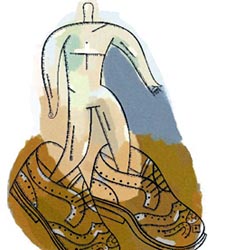 Who are our leaders, and who cares?
By Gary Rosenblatt


JWR contributor Gary Rosenblatt is editor and publisher of the
New York Jewish Week. Comment on this article by clicking here.
