
|
|
|
(JWR) ---- (http://www.jewishworldreview.com)
ALTHOUGH IT WAS NOT SAID EXPLICITLY, I had the feeling that for my Bar
Mitzvah I could ask for any gift.
It was as if every birthday and Hanukah
before this were just stops along the way, each present a prophecy of what
was to come. And there was only one thing I wanted, one thing that could contain
in itself the total idea of gift: a digital watch. The desire for a watch
was a familial one, and I had, at the time, coveted my father's, gold with a
thin window containing an LED display.
I understood progress, and so
requested that mine be LCD and that it have a stopwatch function. I would
never really have a use for the stopwatch, but there was no better
technology to be had. It would be like having the entire CIA on my wrist;
date, calendar and musical alarm tone included.
When I actually got the watch, it was even better than I had imagined, only
the band was too big. There was something oddly shameful about this for me.
It made me feel like while I was considered a man according to my religion
and my family, my body had decided to keep me an awkward skinny adolescent.
I decided not to tell anyone, and kept the watch in my pocket, never without
it, yet unable to wear it with the pride I thought a man should. Yet I still
had my own watch, and I felt akin to my father even more than when I shaved
next to him with my plastic razor years before.
That day I stayed with my older sister at my grandparent's house, and for
the first time, without the collar tugging fingers of elders, I explored the
dark and oily secrets of my grandfather's basement. There were pegboards of
rusty tools, all manner of bolts, wires and a huge powerful vise that
invited fingers and light bulbs. Yet I felt no real connection to my
grandfather in the must and clutter of his workshop. I searched him out,
smelled the tips of oil cans, rubbed my fingers along pockmarked wooden
surfaces and rifled through boxes of magazine and newspapers.
But he wasn't
there.
The only memory I have of my grandfather is being bounced on his knee while
he said, "You're full of baloney." What I know of him are the things that
others have said about him. He was kind and gentle and because he was too
honest, not very good in business. He enjoyed whiskey, sports and he loved
my grandmother. I find it awkward to ask my parents about their own who have
died. So while I understand him only from the way he is eulogized or when I
have the courage to ask my father about him, I do in fact know him in a way
that is beyond familial memories.
I wear his watch.
The watch was not running when my father gave it to me and I brought it in
to a small repair shop and asked for it to be cleaned and repaired. I was
told it was most likely the mainspring, a common problem, and that I could
have it in a week. The worrying about it existed like a little seed in the
back of my mind, a constant feeling that I had forgotten to do something
yesterday, today, or my whole life.
When I went to pick up the watch, I took
it from the man behind the counter and noticed my hand was shaking just a
little. I didn't know how much it meant to me until that moment. Before I
left the store, the clerk called me back and said, "Oh I almost forgot to
tell you. The watchmaker that repaired this watch found his initials on the
back of the case. He had fixed it before more than forty years ago."
The implications escaped me and it wasn't until a few days later that I
realized what he meant. The watchmaker had repaired the same watch for my
grandfather when he owned it, before I was born, when my own father was a
little younger than myself at the time.
Time, although moving and aging me, is standing still in the precise
movements of my grandfather's watch. As I continue to wear it and wind it,
its meaning begins to deepen: history being wound up and released in it, the
history of my family, of a father to his son and then to his own. I begin to
understand my grandfather in small but peculiar ways. I learn a little about
his aesthetic, about the pride of his surname, my name, engraved on the back
in a spiral like cursive. That the watch survived all these years speaks to
the way he cared for things, about things that were made well and deserved
to be preserved, not as an artifact, as I had originally prized it, but as a
useful object.
A thing that needs winding and occasional maintenance.
I can remind myself I that I belong in the world by remembering that I am my
father's son. I notice as I take on the qualities of my father, I catch a
mannerism that doesn't belong to me at all, a gesture I have seen my father
make a hundred times, and yet it is more myself now than the awkward
gestures I try so hard to cultivate. Much in the same way, the nostalgia for
my grandfather's watch is now no longer sentimental, but carved into the
place its sits on my wrist as if it had always belonged to me. I cannot
appropriate that which isn't mine from my grandfather or even my own father.
But I can, in the simple process of winding a watch, create for myself a
character that is my own, yet drawing its energy, just as the spring in the
watch does, from external movements and
Jewish World Review May 3, 1999 / 17 Iyar, 5759
 A Winding History
By Peter Bebergal
 I don't remember my father's father very well. When my grandfather died it
was thought I was too young to attend the funeral. It was years before my
Bar Mitzvah, and so I had no ritual proof of my emotional sophistication.
I don't remember my father's father very well. When my grandfather died it
was thought I was too young to attend the funeral. It was years before my
Bar Mitzvah, and so I had no ritual proof of my emotional sophistication.
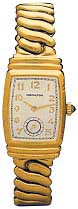
 My grandfather's watch is a 14k gold filled Hamilton with the original
Spidel band that fits me quite well. It has wonderful deco numbers and a
small second hand that runs on its own orbit near the bottom of the face. It
is a little fast, sometimes a little slow, but it winds cleanly and I only
have to do it once a day in the morning. Winding a watch is a remarkable
little ritual. I could say it reminds me of the impermanence of things as
time winds down, or that it reminds me that time is precious and must be
carefully attended to. However, these sentiments don't sit well with me. The
truth is, having to wind the watch is more about the chore of it. Winding
continues the process of making.
My grandfather's watch is a 14k gold filled Hamilton with the original
Spidel band that fits me quite well. It has wonderful deco numbers and a
small second hand that runs on its own orbit near the bottom of the face. It
is a little fast, sometimes a little slow, but it winds cleanly and I only
have to do it once a day in the morning. Winding a watch is a remarkable
little ritual. I could say it reminds me of the impermanence of things as
time winds down, or that it reminds me that time is precious and must be
carefully attended to. However, these sentiments don't sit well with me. The
truth is, having to wind the watch is more about the chore of it. Winding
continues the process of making.
 It wasn't until his watch was given to me, fifteen years later after I owned
my first, that I began to feel a bond to my grandfather, a knowing sense of
what we were in common, not only through blood, but through the things that
we both held as important. Winding a watch carries within it the memory of
these things, in the ritual, the discipline. Simply having to remember a
tiny detail begins the day by building a connection to things made and
crafted, to human things that have value, not in their gold, but in their
inherent precision.
It wasn't until his watch was given to me, fifteen years later after I owned
my first, that I began to feel a bond to my grandfather, a knowing sense of
what we were in common, not only through blood, but through the things that
we both held as important. Winding a watch carries within it the memory of
these things, in the ritual, the discipline. Simply having to remember a
tiny detail begins the day by building a connection to things made and
crafted, to human things that have value, not in their gold, but in their
inherent precision.

New JWR contributor Peter Bebergal is a Cambridge-based writer. You may contact him by clicking here.
