
|
Jewish World Review May 4, 1998 / 18 Iyar, 5759
TODAY is holiday time.
What do you mean, "What holiday?"
Yeah, sure Passover is done.
Come on, where's your spirit? Today is Lag BaOmer. No, I didn't say, "Where's your lawn mower." I said, Lag BaOmer.
This Jewish holiday, falling on the 18th of Iyar, gets little attention, because not too many of us find time to do more than a Passover seder or scramble for High Holiday services.
If I could, I'd send Lag BaOmer to a public relations and marketing person. Because maybe, if we added some sort of fee or price tag to this holiday, we'd be able to generate some more interest.
Got that? Forty-nine.
Okay, during that time our people say a prayer each day blessing something called the omer, which was a biblical barley offering.
During the seven weeks, a major tragedy happened in Jewish history. The heroic scholar, Rabbi Akiva, lost 24,000 students in a plague. They were, according to tradition, punished because they didn't treat one another with respect. History teaches us that about 1,000 years after Rabbi Akiva, the Crusaders in France decimated the European Jewish community during the seven weeks between the second night of Passover and Shavous.
In the 17th Century, Russian Cossacks murdered some 300,000 Jews during the seven weeks.
But then there's the good news, the hope. And that's where Lag BaOmer comes in. Lag, by the way, is the Hebrew numerical equivalent of the number 33.
It was on this day that the dying of Rabbi Akiva's students came to an end. Legend has it that he began teaching all over again, teaching and bringing Torah, beginning with five students. So, the 33rd day of counting of the omer is Lag BaOmer.
From the time after the second seder, tradition has it that we can't have simchas such as weddings, because it is considered a time of mourning. Because we are in mourning, we follow the practice also of not cutting our hair during the mourning period.
In Israel, especially around the area of Meron, it is traditional for people to have bonfires burning. The tradition comes because if the Torah is the light of the world, then a bonfire gives off that sort of light.
There is also another biblical hero associated with this holiday. His name is Rabbi Shimon bar Yochai. Rabbi bar Yochai hid from the Romans for 13 years in a cave. Each year, his students would visit him disguised as hunters. The day of their visit, you guessed it: Lag B'Omer.
They'd learn Torah and feast all through the night, lighting huge bonfires (get the connection here?). When Rabbi bar Yochai died (also on Lag B'Omer), he aked that the death be marked by learning and fasting.
Okay, our public relations person has tragedy to victory. He's got bonfires. He's got weddings, and he can even find a role for a good barber somewhere in there.
In Israel, children are home from school. There are field trips, bonfires are burned, and it's a day of being rather carefree.
So we've go people sitting around the campfire, eating, making merry and even telling the story of the Roman occupation of their country.
What? This isn't a public relations guy's dream?
But maybe we need to charge $50 dollars a person for the bonfire. Maybe if the haircuts had to be certified kosher, then we'd be interested.
How about a Lag B'Omer seder?
A Lag B'Omer prayer book?
How about we just call our synagogue or temple this week or check the internet? There's plenty to do.
Let's not wait for the public relations person.
Let's give it a try.
By the way, do people in their 40s and 50s observe Lag B'Oomer?
Enough of
Marketing Lag BaOmer
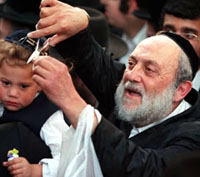
Grandfather takes the first snips of
child's first hair cut on Lag BaOmer in Meron
By Phil Jacobs
 So here's what we have to present to the P.R. guy. From the second seder to the time the Torah is given to the Jewish people at Shavous is 49 days.
 On Lag BaOmer, people get married and they even get their hair cut.
 Let's change the name to "Bonfire Night." No, Lag B'Omer's worked through the centuries.

Phil Jacobs is editor of the Baltimore Jewish Times.

