 |
|
|
Jewish World Review May 12, 1999 /26 Iyar, 5759
LIZ SMITH SAYS gossip is good for us. Writing in the current issue of Brill’s Content, the media monthly, the
syndicated columnist asserts that gossip is cathartic, empowering and comforting — proof that celebrities
have the same kinds of problems we do. She also suggests that gossip is “one of the great luxuries of a
democracy. It is the tawdry jewel in the crown of free speech and free expression.”

Gossip Doesn’t
Set Us Free
By Gary Rosenblatt
 More than harmless fun, Smith adds, gossip “makes you interesting and boosts your self-esteem at having
it to relate.”
More than harmless fun, Smith adds, gossip “makes you interesting and boosts your self-esteem at having
it to relate.”
Perhaps even the Chafetz Chaim would agree with Smith’s last point. The revered rabbi, who wrote a
classic text on the prohibitions against gossip, said that we spread damaging words about others as a
means of elevating ourselves. He suggested that we choose our words in speaking as carefully as we do
when composing a telegram.
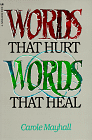
Rabbi Joseph Telushkin, author of an insightful modern-day book on the positive and negative power of
speech, “Words That Hurt, Words That Heal,” believes that the least observed of the 613
commandments in the Torah may well be: “Do not go about as a talebearer among your people”
(Leviticus 19:16).
The prohibition is not only against spreading false information, but the truth, too, though
there are cases when it is permissible to offer an accurate report, such as a character reference (and
newspaper reports).
So much for newspapers, magazines and television talk shows, where gossip has been elevated to the
status of legitimate news. What are we to make, then, of this culture clash between Judaism’s admonition
against discussing others and our society’s glorifying of it?
It comes down to a very real difference between the traditional Jewish and modern American views of
how we see our roles as individuals, and whether anything more than self-gratification is required of us.
The clash of values could not be more stark.
In America today, the Me Generation continues to rule. We are taught to look out for No. 1 —
ourselves — and place great emphasis on a person’s wealth, social status and celebrity. We raise our
children to feel entitled, and believing that they are the center of the universe. Indeed, more and more of
us have our own personal web sites, a technological statement that we believe our lives to be of
enormous interest to others.
Contrast that with Judaism, a religion of mitzvahs, or commandments, serving as constant reminders of one
overall truth: that G-d is the source of all, and we are forever in His debt.  The purpose of this world, we
are taught, is not personal pleasure, but doing what is required of us, performing acts of kindness for
others, and in so doing, bringing glory to our Creator.
The purpose of this world, we
are taught, is not personal pleasure, but doing what is required of us, performing acts of kindness for
others, and in so doing, bringing glory to our Creator.
In the Torah portion, Kedoshim, we read several weeks ago G-d’s curt but powerful challenge and
command: “You shall be holy, for I, the L-rd your G-d, am holy.”
What exactly is required of us? Our rabbis suggest that holiness is about separation. We must not only
separate ourselves from the other nations of the world, but also, in a sense, from ourselves. That is to
say, we are reminded that we are not the center of the universe. G-d is. And the more we remember that
there is a world beyond our own needs and desires, the more capable we will be of doing kindness to
others.
American Jews are uncomfortable with having to choose between values of Judaism and modernity. We
would prefer to think that they are not in conflict, but they are at times. Most American Jews are liberals,
for example, so how do we respond when our tolerance toward homosexuality or abortion may be at
odds with classical Jewish teaching?  Do we simply dismiss the Jewish concept as old-fashioned and
narrow-minded, or do we seek to understand the roots and motives of the traditional viewpoint?
Whichever way we choose to act, we should at least be knowledgeable of what our Jewish heritage has
to say, and why.
Do we simply dismiss the Jewish concept as old-fashioned and
narrow-minded, or do we seek to understand the roots and motives of the traditional viewpoint?
Whichever way we choose to act, we should at least be knowledgeable of what our Jewish heritage has
to say, and why.
Gossip is a case in point, for while Liz Smith claims it’s harmless, the rabbis of old reflected a greater
wisdom, recognizing that once words of lashon hara (literally, evil tongue) are spoken, they can never be
retrieved. It is the Jewish tradition — not our modern society — that places the utmost respect on each
individual as created in the image of G-d, and it is incumbent on us to take those time-honored teachings
to

JWR contributor Gary Rosenblatt is Editor and publisher of the
New York Jewish Week. Send your comments to him by clicking here.

