
Jewish World Review March, 8, 1998 /20 Adar, 5759
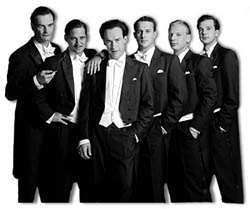 |
| The original Comedian Harmonists |
By Curt Schleier
THE COMEDIAN HARMONISTS, the singing group on which the new play
Band in Berlin is based, was banned in Berlin before the war. Two of its
members were Jews and a third, though baptized and raised Catholic, had a
Jewish grandmother, more than enough blood to win the Hebrew lottery.
Under pressure from the Nazi regime, what was at the time one of the most
popular acts in Europe was forced to split up. And while the Jews who
emigrated, ultimately to the U.S., prospered briefly, the group fell out of
sight and out of popular memory--until recently.
Susan Feldman, who wrote, conceived and co-directed the play, first
heard about the Harmonists in 1991. Feldman, 49, is artistic director and
founder of the St. Ann Center for Restoration and the Arts. For the past
two decades, she has raised funds to restore a historic Brooklyn Heights
national landmark church and used it as a venue for a variety of
performances, ranging from puppetry to film, but mostly musical events.
Quite by coincidence, a three-hour documentary about the group by German
film maker Fechner Eberhardt was playing at the Public Theater. But that
was made up exclusively of interviews with the surviving members of the
group or surviving family, and had no performance footage.
It was, Feldman decided, "like hearing about the Beatles and
hearing about Frank Sinatra, but never seeing them perform." So she and
Wilbur Pauley, one of the singers in the Weill show, created what
eventually became this play. "We thought we would juxtapose this beautiful,
fun sound, against the reality of what was going on; the vibrancy of the
period against the creepy, crawling final solution."
It was performed at St. Ann's in its first incarnation, and
subsequently on public radio and in Rochester, each version getting closer
to its present format. At first the group's story was told in a
traditional way, with a linear narrative. But over time Band evolved into
something more closely resembling Beatlemania. In that show, four young
men sang Beatle songs while films and other images of the era flashed on
screens behind them.
In Band in Berlin, too, five singers and a piano player reasonably
faithfully duplicate the group's sound: intricate harmonies that fall
somewhere between a barbershop quintet and the best of the Beach Boys,
around the Pet Sounds album. They recreate, too, the band's act, the way
it used the piano as a sixth singer, how the singers used their voices as
musical instruments and how they joked and played on stage. It is a
delightful entertainment. The on-stage performers have no dialogue. They
sing and play and make it obvious why the Comedian Harmonists were the rage
of Europe between 1927 and 1935, the period during which the play takes
place.
But the real meat of the production goes on behind the performers,
slides and film, some new, some archival, and with some artistic license a
recreation of interviews conducted by Feldman and Cott with Roman Cycowski,
the last surviving Harmonist. He lived in Palm Springs where he served as
a cantor at Temple Isaiah until his death last November at age 91. The
production is dedicated to him.
Feldman remembers visiting Cycowski in Palm Springs. "He took me to
schul with him one Saturday morning, and sang the whole service. You never
would have thought listening to that voice that he was 91 years old. I
told him you sound fantastic. ‘Well,' he said, ‘it's only the morning. I
haven't warmed up yet.
"When I met him it wasn't like talking to an old person. It was
like talking to a musician. He had so much insight into pre-war Germany,
the culture and what it was like then. He once said to me ‘Hitler spoiled
everything.' He loved the German culture. That was very meaningful to me.
I grew up Jewish but knew only the Germany of the Holocaust."
According to Feldman, Cycowski has mixed feelings about being the
survivor, about being the only one left to tell the story. The Harmonists
records were re-mastered and re- released in Germany during the '80s,
precipitating renewed interest in the group. More recently, their music
was released on CDs. "So he was being interviewed all the time. I was one
of the first Americans to interview him. The Germans were always looking
for bitterness. But he had very little bitterness, and he wasn't bitter at
all towards Germany. He thought Hitler was the problem."
There was no anti-Semitism in the group--at least on the surface
and in the beginning. Cycowski told Feldman the Christians were very
respectful of the Jews, and did not perform on the Holy Days. "But as time
went on," Feldman says, "things got a little dicier."
The Harmonists had the resources to leave Germany together, but the
Christian members elected to stay, hoping that substitutes for departing
members would enable them to continue. But they were never able to
recapture the magic. The Jewish members went first to Vienna where they
added a pianist, and were successful for a while, first there, then in the
rest of Europe, Australia and finally the U.S. But when Cycowski received
word that his father had been killed, he left show business to fulfill a
promise he'd made to his father to become a cantor.
He'd trained to become a chazen in Poland before coming to Germany,
first to sing opera and then perform with the group.
Working on this production has been an emotional experience for
Feldman. She grew up in the Rockaway section of Queens, in what was a
typical Jewish household of the period. She went to Hebrew School, the
family got together for the Holidays, but the Holocaust was not discussed.
Her father, a doctor, "was a medic during the war and actually went into
the camps when they were liberated. He rarely ever talked about it, but it
had a profound affect on him and that was passed on to me. As a kid I read
The Diary of Anne Frank and remember thinking, that could have been me. It
was a presence we all felt.
"Working over at St. Ann's I did a lot of researching of
documentary film footage [for the production] and I would just get
overwhelmed some times--and here her voice breaks briefly-- and wonder How
could this happen? What were people doing? When we were making the Nazi
banners and flags, I was thinking, this is what people all over Germany
were doing."
The emotions were confusing for her. "Where was this coming from?"
she wondered. "I haven't been walking around obsessing about the Holocaust
all my life."
One of the special moments for her came during the initial run,
back in 1992 at St. Ann's.
Her father came to the premiere. They weren't sitting together, but she
knew he was in the audience.
"I just said to myself, this is for
 In 1991, Feldman was running a Kurt Weil concert, when a friend
remarked how much the four singers she'd hired to sing Weil tunes sounded
like the Harmonists. Her reaction was, "the who?"--which is of course a
completely different ensemble. The friend, music journalist Jonathan Cott,
loaned her records of the Harmonists and she became fascinated with them.
In 1991, Feldman was running a Kurt Weil concert, when a friend
remarked how much the four singers she'd hired to sing Weil tunes sounded
like the Harmonists. Her reaction was, "the who?"--which is of course a
completely different ensemble. The friend, music journalist Jonathan Cott,
loaned her records of the Harmonists and she became fascinated with them.

JWR contributor Curt Schleier is a freelance writer and author who also teaches
writing to business executives. Send your comments to him by clicking here.

