|


Whose Jerusalem?
Islam and the Holy City in historical context
By Daniel Pipes
The Israeli decision to build a new neighborhood in
The Jewish connection is one both ancient and pervasive.
Jerusalem stands as the paramount religious city of Judaism, a place so holy that not just its soil but even its air is deemed sacred. Jews pray in its direction, mention its name constantly in prayers, close the Passover service with the wistful statement "Next year in Jerusalem," and recall the city in the blessing at the end of meals. The destruction of the Temple looms very large in Jewish consciousness; remembrance takes such forms as a special day of mourning, houses left partially unfinished, a woman's makeup or jewelry left incomplete, and a glass smashed during the wedding ceremony. In addition, Jerusalem has had a prominent historical role, is the only capital of a Jewish state, and is the only city with a Jewish majority during the whole of the past century.
What about Muslims? Where does Jerusalem fit in Islam and Muslim history? It is not the place to which they pray, is not once mentioned by name in the Qur'an or in prayers, and it is directly connected to no events in Muhammad's life. The city never served as capital of a sovereign Muslim state, and it never became a cultural center. Little of political import by Muslims was ever initiated there.
This being the case, why is Jerusalem these days the focus of so much Muslim interest? Because of politics. A survey of Islamic history shows that the status of the city inevitably rises, as do emotions surrounding it, when this serves a political purpose. Conversely, when the utility of Jerusalem expires, so does its status and the passions. The Prophet Muhammad himself established this pattern in the early 7th century. Since then, it has been repeated on at least four other occasions: in the late 7th century, in the 12th century Countercrusade, during the era of British rule (1917-48), and since 1967. Going back almost fourteen centuries, these episodes provide an important perspective on the current diplomatic impasse.
Muhammad fled his home town of Mecca for Medina in 622 AD, and in the process moved to a place with a substantial Jewish population. On arrival in Medina, if not earlier, he adopted a number of practices friendly to Jews: a Yom Kippur-like fast, a synagogue-like place of prayer, permission to eat kosher food, and approval to marry their women. Most important, Muhammad adopted the Judaic practice of facing the Temple Mount in Jerusalem during prayer; "He chose the Holy House in Jerusalem in order that the People of the Book [i.e., Jews] would be conciliated," notes At-Tabari, an early Muslim commentator on the Qur'an, "and the Jews were glad." Modern historians agree: W. Montgomery Watt, a leading biographer of Muhammad, interprets the prophet's "far-reaching concessions to Jewish feeling" in the light of two motives, one of which was "the desire for a reconciliation with the Jews."
But Jews rejected Muhammad's gestures and instead criticized the new faith, so that he eventually broke with them, probably in early 624. The most dramatic sign of this change in attitude came in a Qur'anic passage (2:142-52) ordering the faithful no longer to pray toward Syria but instead toward Mecca. (The Qur'an and other sources only mention the direction as "Syria"; other information makes it clear that Jerusalem is meant.) This episode set the mold that would be repeated many times over succeeding centuries: Muslims take interest religiously in Jerusalem because of pressing concerns of a mundane and temporary sort. Then, when those concerns lapse, so does the intense interest in Jerusalem, and the city's standing diminishes.
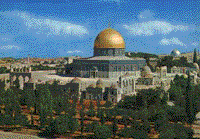
The second episode came soon thereafter, in the era of the Damascus-based Umayyad dynasty (661-750). Embroiled in competition with a dissident leader in Mecca, the Umayyad rulers sought to aggrandize Syria at the expense of that Arabian town (and perhaps also to help recruit a Muslim army against the Byzantine Empire). Toward this end, they took some steps to sanctify Damascus, but mostly this effort involved Jerusalem. The first Umayyad ruler chose Jerusalem as the place where he ascended to the caliphate and possibly had plans to make Jerusalem the capital of his empire. But Jerusalem is primarily a city of faith, and, as the Israeli scholar Izhak Hasson explains, the "Umayyad regime was interested in ascribing an Islamic aura to its stronghold and center." Toward this end (and perhaps also to assert Islam's presence in its competition with Christianity), the rulers in 688-91 built Islam's first grand structure, the Dome of the Rock, right on the spot of the Jewish Temple. This remarkable building is not just the first monumental sacred building of Islam but also the only one that still stands today in roughly its original form.
The next Umayyad step was subtle and complex, and requires a pause to note a passage of the Qur'an. Sura 17:1, describing Muhammad's Night Journey (isra'), reads:
The Dome of the Rock itself emphasizes Islamic associations to the Temple Mount but has no ostensible connection to the Night Journey. In particular, not one of the many inscriptions in a mosaic frieze that extends 240 meters on the Dome of the Rock alludes to this event. And Muhammad ibn al-Hanafiya (638-700), a close relative of the Prophet Muhammad, is quoted denigrating the notion that the prophet ever stepped foot on the Rock in Jerusalem.
But then, in 715, the Umayyads did a most clever thing: they built a mosque in Jerusalem, right on the Temple Mount, and called it the Furthest Mosque (al-masjid al-aqsa, Al-Aqsa Mosque). With this, the Umayyads not only post hoc inserted Jerusalem into the Qur'an but retroactively gave the city a prominent role in Muhammad's life. For if the "furthest mosque" is in Jerusalem, then Muhammad's Night Journey and his subsequent ascension to heaven (mi`raj) also took place on the Temple Mount -- indeed, at the very rock from which Jesus had ascended to heaven.
Other passages of the Qur'an also were interpreted to refer to Jerusalem, giving the city a holy aura. The city came to be seen as the site of the Last Judgment. The Umayyads abandoned the unreligious Roman name for the city, Aelia Capitolina (in Arabic, Iliya) and replaced it with Al-Quds (The Holy) or Bayt al-Maqdis (The Temple). They sponsored a genre of literature praising the "virtues of Jerusalem." Accounts of the prophet's sayings or doings (called hadiths) favorable to Jerusalem emerged at this time, some of them equating the city with Mecca. There was even an effort to move the pilgrimage (hajj) from Mecca to Jerusalem.
It bears emphasis that the Umayyads' motivation to assert a Muslim presence in the sacred city had a utilitarian purpose. Again, quoting Hasson:
Then, with the Umayyad demise in 750 and the move of the imperial capital to Baghdad, Jerusalem fell into near-obscurity. For the next three and a half centuries, books praising this city lost favor and the construction of glorious buildings not only came to an end but existing ones fell apart (the Dome over the rock collapsed in 1016). Worse, the rulers of the new dynasty bled Jerusalem and its region country through what F. E. Peters of New York University calls "their rapacity and their careless indifference." The city declined to the point of becoming a shambles. "Learned men are few, and the Christians numerous," bemoaned a tenth-century Muslim native of Jerusalem. In a typical put-down, another tenth-century author described the city as "a provincial town attached to Ramla," a reference to the tiny, insignificant place serving as Palestine's administrative center.
Scholars unanimously agree with this characterization. Emmanuel Sivan of the Hebrew University writes that "belief in the sanctity of Jerusalem cannot be said to have been widely diffused nor deeply rooted in Islam." His colleague Amikam Elad characterizes Jerusalem in the early centuries of Muslim rule as "an outlying city of diminished importance." The great historian S. D. Goitein finds that, in its first six centuries of Muslim rule, "Jerusalem mostly lived the life of an out-of-the-way provincial town, delivered to the exactions of rapacious officials and notables, often also to tribulations at the hands of seditious fellahin [peasants] or nomads... Jerusalem certainly could not boast of excellence in the sciences of Islam or any other fields."
By the early tenth century, notes Peters, Muslim rule over Jerusalem had an "almost casual" quality with "no particular political significance." In keeping with this near-indifference, the Crusader conquest of the city in 1099 aroused a very mild initial response from Muslims. The Franks did not rate much attention and, in Sivan's words, "one does not detect either shock or a sense of religious loss and humiliation."
This mild response meant that, in the words of British scholar Robert Irwin, "calls to jihad at first fell upon deaf ears." Only as the effort to retake Jerusalem grew serious in about 1150 did Muslim leaders seek to rouse jihad sentiments through the heightening of emotions about Jerusalem. Using the means at their disposal (hadiths, "virtues of Jerusalem" books, poetry), their agents stressed the sanctity of Jerusalem and the urgency of its return to Muslim rule. Newly-minted hadiths made Jerusalem ever-more critical to the Islamic faith; one of them put words into the Prophet Muhammad's mouth saying that, after his own death, Jerusalem's falling to the infidels is the second greatest catastrophe facing Islam. Whereas not a single "virtues of Jerusalem" volume appeared in the period 1100-50, very many came out in the subsequent half century. In the 1160s, Sivan notes, "al-Quds propaganda blossomed"; and when Saladin led the Muslims to victory over Jerusalem in 1187, the "propaganda campaign . . . attained its paroxysm."
The glow of the reconquest remained bright for several decades thereafter; for example, Saladin's successors went on a great building and restoration program in Jerusalem, thereby imbuing Jerusalem with a more Muslim character. Until this point, Islamic Jerusalem had consisted only of the shrines on the Temple Mount; now, for the first time, specifically Islamic buildings (Sufi convents, schools) were built in the surrounding city. Also, it was at this time, Oleg Grabar of Princeton's Institute of Advanced Study notes, that the Dome of the Rock came to be seen as the exact place where Muhammad ascended to heaven during his Night Journey.
But once safely back in Muslim hands for some years, interest dropped again, to the point that one of Saladin's grandsons ceded the city in 1229 to Emperor Friedrich II in return for the German's promise of military aid against his brother, a rival king. Learning that Jerusalem was back in Christian hands again provoked intense Muslim emotions; by 1244, the city was again under Muslim rule, this time to remain so for nearly eight centuries.
The psychology at work here bears note: that Christian knights traveled from distant lands to make Jerusalem their capital made the city more valuable in Muslim eyes too. "It was a city strongly coveted by the enemies of the faith, and thus became, in a sort of mirror-image syndrome, dear to Muslim hearts," Sivan explains. Thus did fractured opinions turn into a powerful sensibility; political exigency caused Muslims ever after to see Jerusalem as the third most holy city of Islam.
But then the city lapsed back to its usual obscurity -- capital of no dynasty, economic laggard, cultural backwater -- though its new-found prestige as an Islamic site remained intact. Lack of interest translated into decline and impoverishment. The city's walls were razed in 1219and not rebuilt for over three centuries, during which time Jerusalem served as easy prey to marauders. The Temple Mount sanctuaries were abandoned and became dilapidated. A fourteenth-century author bemoaned the paucity of Muslims visiting Jerusalem. During the Mamluk era (1250-1516), Jerusalem was a favorite place to exile political leaders, and they quite often endowed religious institutions; but otherwise Mamluk rule so devastated Jerusalem that the town's entire population at the end of their rule amounted to a miserable four thousand souls. By then, many of the grand buildings were abandoned as the city became depopulated.
The long Ottoman period (1516-1917) got off to an excellent start when Suleiman the Magnificent rebuilt the city walls in 1537-41 and lavished money in Jerusalem, but things quickly reverted to normal. Jerusalem now suffered from the indignity of being treated as a tax farm for non-resident, one-year (and so very rapacious) officials. "After having exhausted Jerusalem, the pasha left," observed the French traveler François-René Chateaubriand in 1806. The Turkish authorities raised plenty of funds by gouging European visitors, and so made less effort than in other cities to promote Jerusalem's economy. The tax rolls show soap as its only export. By 1806, the population had again dropped, this time to less than 9,000 residents.
Innumerable reports during these centuries from Western pilgrims, tourists, and diplomats in Jerusalem told of the city's execrable condition. George Sandys in 1611 found that "Much lies waste; the old buildings (except a few) all ruined, the new contemptible." Constantin Volney, one of the most scientific of observers, noted in 1784 Jerusalem's "destroyed walls, its debris-filled moat, its city circuit choked with ruins." "What desolation and misery!" wrote Chateaubriand. Gustav Flaubert of Madame Bovary fame visited in 1850 and found "Ruins everywhere, and everywhere the odor of graves. It seems as if the Lord's curse hovers over the city. The Holy City of three religions is rotting away from boredom, desertion, and neglect." "Hapless are the favorites of heaven," commented Herman Melville in 1857. Mark Twain in 1867 wrote that Jerusalem "has lost all its ancient grandeur, and is become a pauper village."
In modern times, notes the Israeli scholar Hava Lazarus-Yafeh, Jerusalem "became the focus of religious and political Arab activity only at the beginning of the present century, and only because of the renewed Jewish activity in the city and Judaism's claims on the Western Wailing Wall." British rule over city, lasting from 1917 to 1948, further galvanized passion for Jerusalem. The Palestinian leader (and mufti of Jerusalem) Haj Amin al-Husseini made the Temple Mount central to his anti-Zionist efforts. More, Husseini exploited the emotional issue of the holy places in Jerusalem to find international Muslim support for anti-Zionism. For example, he engaged in fundraising in several Arab countries to restore the Dome of the Rock and Al-Aqsa, sometimes by sending out pictures of the Dome of the Rock under a Star of David, and succeeded in restoring these monuments to their former glory. He resisted any Jewish access to the Western Wall on the grounds that this could next lead to claims on the Temple Mount itself. He brought a contingent of Muslim notables to Jerusalem in 1931 for an international congress to mobilize global Muslim opinion on behalf of the Palestinians.
Arab politicians made Jerusalem a prominent destination. During the Mandatory period, Iraqi leaders frequently turned up in Jerusalem, where they demonstrably prayed at Al-Aqsa and gave rousing speeches. Most famously, King Feisal of Iraq visited the city and made a ceremonial entrance to the Temple Mount using the same gate as did the caliph when the city was first conquered in 638. Iraqi involvement also included raising funds for an Islamic university in Jerusalem, setting up a consulate and an information office there.
Sandwiched between British and Israeli eras, Jordanian rule over Jerusalem in 1948-67 offers a useful control case; true to form, when Muslims took the Old City (which contains the sanctuaries) they noticeably lost interest in the place. An initial excitement stirred when the Jordanian forces took the walled city in 1948 -- as evidenced by the Coptic bishop's crowning King 'Abdallah as "King of Jerusalem" in November of that year -- but then the usual ennui set in. The Hashemites had little affection for Jerusalem, where some of their most devoted enemies lived and where 'Abdallah himself was shot dead in 1951. In fact, the Hashemites made a concerted effort to diminish the holy city's importance in favor of their capital, Amman. Jerusalem had served as the British administrative capital, but now all government offices there (save tourism) were shut down; no longer did Jerusalem even have authority over other parts of the West Bank. The Jordanians also closed some local institutions (e.g., the Arab Higher Committee) and moved others to Amman (the treasury of the Palestinian waqf, or religious endowment).
Jordanian efforts succeeded: once again, Arab Jerusalem became an isolated provincial town, now even less important than Nablus. The economy so stagnated that many thousands of Arab Jerusalemites left town: while the population of Amman increased five-fold in the period 1948-67, that of Jerusalem grew by just 50 percent. To take out a bank loan meant traveling to Amman. Amman was chosen for the country's first university as well as the royal family's many residences. Perhaps most insulting of all, Jordanian radio broadcast the Friday prayers not from Al-Aqsa Mosque but from some mosque in Amman. (Ironically, Radio Israel began broadcasting Al-Aqsa services immediately after the Israel victory in 1967.) Jerusalem Arabs knew full well what was going on, as evidenced by one notable's complaint about the royal residences being built in Amman: "those palaces should have been built in Jerusalem, but were removed from here, so that Jerusalem would remain not a city, but a kind of village." East Jerusalem's Municipal Counsel twice formally complained about Jordanian discrimination.
Nor were Jordan's rulers alone in ignoring Jerusalem; the city virtually disappeared from the Arab diplomatic map. Malcolm Kerr's well-known study on inter-Arab relations during this period, The Arab Cold War, appears not once to mention the city. No foreign Arab leader came to Jerusalem during the time that Jordan controlled East Jerusalem, and King Hussein only rarely visited. King Feisal of Saudi Arabia often spoke after 1967 of yearning to pray in Jerusalem, yet he appears never to have bothered to pray there when he had the chance. Perhaps most remarkable is that the PLO's founding document, the Palestinian National Covenant of 1964, does not once mention Jerusalem or even allude to it.
All this abruptly changed after June 1967, when the Old City came under Israeli control; as in the British period, Palestinians again made Jerusalem the centerpiece of their political program. The Dome of the Rock turned up everywhere, from Yasser Arafat's office to the corner grocery, slogans about Jerusalem proliferated, and it quickly became the single most emotional issue of the Arab-Israeli conflict. The PLO Covenant continued not to mention Jerusalem but the 1968 Constitution made up for this oversight by specifically mentioning Jerusalem as "the seat of the Palestine Liberation Organization."
Nor were Palestinians alone in this emphasis on Jerusalem: "as during the era of the Crusaders," Lazarus-Yafeh points out, many Muslim leaders "began again to emphasize the sanctity of Jerusalem in Islamic tradition." In the process, they even relied on the same arguments (e.g., rejecting the occupying power's religious connections to the city) and the same hadiths to back up those allegations. Jerusalem became a mainstay of Arab League and United Nations resolutions. In addition, the Jordanian and Saudi Arabian governments now gave as munificently to the Jerusalem waqf as they had been stingy before 1967.
As in the Mandatory period, Jerusalem became the best issue for mobilizing Muslim opinion internationally; this became especially clear in September 1969, when King Faysal parlayed a fire at Al-Aqsa Mosque into the impetus to convene twenty-five Muslim heads of state and establish the Organization of the Islamic Conference, a United Nations for Muslims. In Lebanon, the fundamentalist group Hizbullah depicts the Dome of the Rock on everything from wall posters to scarves and under the picture often repeats its slogan: "We are advancing." Lebanon's leading Shi'i authority, Muhammad Hussein Fadlallah, regularly exploits the theme of liberating Jerusalem from Israeli control to inspire his own people; he does so, explains his biographer Martin Kramer, not for pie-in-the-sky reasons but "to mobilize a movement to liberate Lebanon for Islam."
Since shortly after its founding, the Islamic Republic of Iran has issued a 1-rial coin and 1000-rial banknote featuring the Dome of the Rock (though, embarrassingly, the latter initially was mislabelled "Al-Aqsa Mosque"). Iranian soldiers at war with Saddam Hussein's forces in the 1980s received primitive maps showing their sweeping through Iraq and onto Jerusalem. Ayatollah Khomeini decreed the last Friday of Ramadan as Jerusalem Day, and the holiday has served as a major occasion for anti-Israel harangues in many countries, including Turkey, Tunisia, and Morocco. The Islamic Republic of Iran celebrates the holiday with stamps and posters featuring scenes of Jerusalem accompanied by exhortative slogans. In February 1997, President Hashemi Rafsanjani celebrated Jerusalem Day by telling a crowd of some 300,000 that "There is no government in this region called Israel."
However minor Jerusalem's role in Islamic history, it has become common for revisionist Muslims in the past thirty years to claim passionate attachment to the city. A new "virtues of Jerusalem" literature has developed. Four aspects of this claim might cause the historian to raise an eyebrow. First, they assert a connection to Jerusalem that goes back further than the Jewish one. Ghada Talhami, a scholar, typically asserts that "There are other holy cities in Islam, but Jerusalem holds a special place in the hearts and minds of Muslims because its fate has always been intertwined with theirs." Always? Jerusalem's founding antedated Islam by about two millennia, so how can that be? Ibrahim Hooper, national communications director for the Washington-based Council on American-Islamic Relations, elaborates on this extraordinary claim: "the Muslim attachment to Jerusalem does not begin with the prophet Muhammad, it begins with the prophets Abraham, David, Solomon and Jesus, who are also prophets in Islam." In other words, the central figures of Judaism and Christianity were really proto-Muslims.
Second, and equally anachronistic, is the claim that the Qur'an mentions Jerusalem. Hooper (and others) argue that "the Koran refers to Jerusalem by its Islamic centerpiece, al-Aqsa Mosque." But this makes no sense: a mosque built a century after the Qur'an was delivered cannot establish what a Qur'anic verse originally meant.
Third, some Muslims have the temerity to deny that Jerusalem has any importance to Jews. School textbooks allude to the city's role in Christianity and Islam, but not in Judaism. King Feisal spoke with undisguised scorn of the Jewish attachment to the Western (or Wailing) Wall, the only portion of the ancient Temple that still stands: "The Wailing Wall is a structure they weep against, and they have no historic right to it. Another wall can be built for them to weep against." In response to the Israeli victory in 1967, a top Islamic official of the Temple Mount portrayed Jewish claims to the Western Wall as an act of "aggression against al-Aqsa mosque." This spirit lives on. 'Abd al-Malik Dahamshe, an Arab member of Israel's parliament, flatly stated that "the Western Wall is not associated with the remains of the Jewish Temple." The Palestinian Authority's website states about the Western Wall that "Some Orthodox religious Jews consider it as a holy place for them, and claim that the wall is part of their temple which all historic studies and archeological excavations have failed to find any proof for such a claim." A fundamentalist Israel Arab leader went further and announced that "It's prohibited for Jews to pray at the Western Wall."
Others reject any Jewish connection to the Temple Mount. The director of the Al-Aqsa Mosque, Sheikh Muhammad Hussein, recently asserted that "This is a place for Muslims, only Muslims. There is no temple here, only Al Aksa Mosque and the Dome of the Rock... There is no place for argument." Or, in the succinct wording of a banner carried to protest Har Homa: "Jerusalem is Arab."
Fourth, Muslim institutions pressure the Western media to call the Temple Mount and the Western Wall by their Islamic names (Al-Haram ash-Sharif, Al-Buraq), and not their much older Jewish names. When Western journalists do not comply, the PLO responds with outrage. Its news agency, for example, portrays a reluctance to rename the sites as part of a "constant conspiracy against our sanctities in Palestine."
Despite these deafening claims that Jerusalem is essential to Islam, the religion does contain a recessive but persistent strain of anti-Jerusalem sentiment, on the grounds that so much emphasis on Jerusalem is non-Islamic. Perhaps the most prominent adherent of this view was Ibn Taymiya (1263-1328), one of the Islam's strictest and most influential religious thinkers. (The Wahhabis of Saudi Arabia are his modern-day successors.) In an attempt to purify Islam of accretions and impieties, Ibn Taymiya dismissed the sacredness of Jerusalem as a notion deriving from Jews and Christians, and from the long-ago Umayyad rivalry with Mecca. Ibn Taymiya's successor, Ibn Qayyim al-Jawziya (1292-1350), also rejected hadiths about Jerusalem as false. More broadly, learned Muslims living after the Crusades knew that the great publicity given to hadiths extolling Jerusalem's sanctity resulted from the Countercrusade -- from political exigency, that is -- and therefore treated it warily.
In this light, the fact that Muslims for almost a year and a half during Muhammad's lifetime directed prayers toward Jerusalem had a permanently contradictory effect on that city's standing in Islam. The incident partially imbued Jerusalem with prestige and sanctity, but it also made the city a place uniquely rejected by God. Some early hadiths have Muslims expressing this rejection by purposefully praying with their back to Jerusalem, a rejection that still survives in vestigial form; he who prays in Al-Aqsa Mosque not coincidentally shows his back precisely to the Temple area toward which Jews pray.
In Jerusalem, theological and historical claims matter; they are the functional equivalent to the deed to the city. That politics, and not lasting religious sensibility, has long fueled the Muslim attachment to Jerusalem has two implications. First, it suggests that the Muslim interest lies not so much in controlling Jerusalem as it does in denying control over the city to anyone else. Second, it points to the relative weakness of the Islamic connection to the city, one that arises as much from transitory considerations of mundane need as from the immutable claims of faith. Jerusalem will never be more than a secondary city for Muslims.
Mecca, by contrast, is the eternal city of Islam, the place where Muslims believe Abraham nearly sacrificed Isaac's brother Ishmael and toward which Muslims pray five times each day. Non-Muslims are strictly forbidden there, and the city's "very mention reverberates awe in Muslims' hearts," writes Abad Ahmad of the Islamic Society of Central Jersey. Very roughly speaking, what Jerusalem is to Jews, Mecca is to the Muslims. And just as Muslims rule an undivided Mecca, so Jews should rule an undivided Jerusalem.
 eastern Jerusalem has aroused a vociferous Palestinian and Muslim response, with Yasser Arafat and others going so far as to say that this move jeopardizes the entire peace process. And so, once again, the issue of Jerusalem proves itself to be the very knottiest of all those that face Arab and Israeli negotiators. In part, the problem is practical: the Palestinians insist that the capital of Israel serve as the capital of their future state too.
But much more, it is a matter of high emotions because the ancient city has sacred associations for both Jews and Muslims. (Not to speak of Christians; but Christians today make no independent political claim to Jerusalem.)
eastern Jerusalem has aroused a vociferous Palestinian and Muslim response, with Yasser Arafat and others going so far as to say that this move jeopardizes the entire peace process. And so, once again, the issue of Jerusalem proves itself to be the very knottiest of all those that face Arab and Israeli negotiators. In part, the problem is practical: the Palestinians insist that the capital of Israel serve as the capital of their future state too.
But much more, it is a matter of high emotions because the ancient city has sacred associations for both Jews and Muslims. (Not to speak of Christians; but Christians today make no independent political claim to Jerusalem.)
[God] takes His servant [i.e., Muhammad] by night from the Sacred Mosque to the furthest mosque.
When this Qur'anic passage was first revealed, in about 621, a place called the Sacred Mosque already existed in Mecca. In contrast, the "furthest mosque" was a turn of phrase, not a place. Some early Muslims understood it as metaphorical or as a place in heaven. And if the "furthest mosque" did exist on earth, Palestine would seem an unlikely location, for that region elsewhere in the Qur'an (30:1) was called "the closest land" (adna al-ard). And indeed the earliest Muslim accounts of Jerusalem, such as the description of Caliph 'Umar's reported visit to the city just after the Muslims conquest in 638, do not identify the city or the Temple Mount with the "furthest mosque" of the Qur'an.
The construction of the Dome of the Rock and al-Aqsa mosque, the rituals instituted by the Umayyads on the Temple Mount and the dissemination of Islamic-oriented Traditions regarding the sanctity of the site, all point to the political motives which underlay the glorification of Jerusalem among the Muslims.
Thus did the Umayyads' political decision to elevate the standing of Jerusalem have theological consequences; thus did their building program directly lead to the sanctification of Jerusalem.


Daniel Pipes is the editor of the Middle East Quarterly.